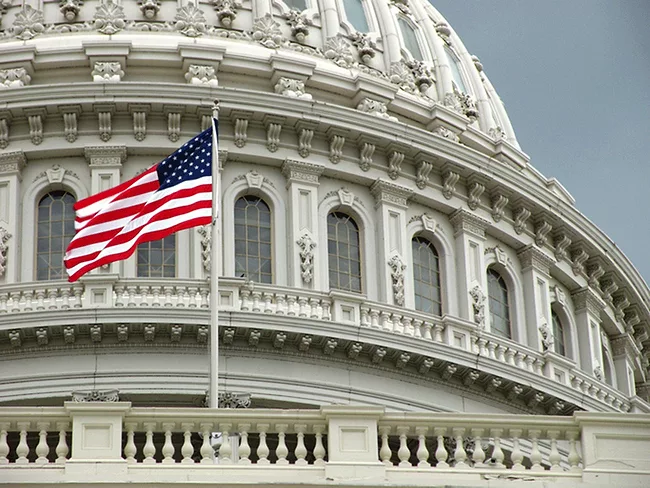
Both chambers of the U.S. Congress put aside their election year politicking Sept. 25 long enough to pass a continuing resolution that will keep the government running at its current funding level through Dec. 20. The spending bill is now awaiting President Joe Biden’s signature.
The FTC’s request for a nearly 25% increase in funding for fiscal 2025 was splashed with cold water May 15 in a U.S. House Appropriations subcommittee hearing. That’s “a dramatic increase in funding for an agency whose work continues to raise concerns among many members of Congress and the public,” Rep. David Joyce (R-Ohio), chair of the Subcommittee on Financial Services and General Government, said as he opened the hearing.
The FTC’s request for a nearly 25% increase in funding for fiscal 2025 was splashed with cold water May 15 in a U.S. House Appropriations subcommittee hearing. That’s “a dramatic increase in funding for an agency whose work continues to raise concerns among many members of Congress and the public,” Rep. David Joyce (R-Ohio), chair of the Subcommittee on Financial Services and General Government, said as he opened the hearing.
In recent years, the U.S. Congress has come to rely unduly on continuing budget resolutions to fund government operations, and fiscal year 2024 is no exception. The current continuing resolution (CR) for the FDA budget is set to expire March 1, but there is concern that Congress will resort yet again to a CR to cover the balance of fiscal 2024, a predicament which suggests that the FDA’s appropriations may be flat relative to fiscal year 2023.
The Advanced Research Projects Agency for Health (ARPA-H) reported the opening of a series of regional offices that focus on both administrative and research assignments, a development that may bolster cures and treatments for tough-to-treat conditions. However, the U.S. House and Senate have different ideas about how much money the agency will receive in 2024, casting a cloud of uncertainty over how many projects the agency will be able to finance in the twelve months that will start on Oct. 1, 2023.
The Advanced Research Projects Agency for Health (ARPA-H) reported the opening of a series of regional offices that focus on both administrative and research assignments, a development that may bolster cures and treatments for tough-to-treat conditions. However, the U.S. House and Senate have different ideas about how much money the agency will receive in 2024, casting a cloud of uncertainty over how many projects the agency will be able to finance in the twelve months that will start on Oct. 1, 2023.
A committee of the U.S. House of Representatives wrapped up business in a late-running June 14 markup of spending bills that would give the U.S. FDA roughly $6.6 billion to work with in fiscal 2024. However, the final bill omits language in the manager’s mark that had called on the FDA to engage in rulemaking or guidance development for lab-developed tests, but the FDA made up for that by adding a proposal to engage in rulemaking for LDTs in its regulatory agenda.
The June 14 hearing of the House Appropriations Committee was focused largely on spending levels for the Department of Agriculture, but there was also some concern over the proposed spending levels for the FDA. One of the more conspicuous features of the legislative report is the recommendation that the FDA finalize guidance or rulemaking for risk-based regulation of lab-developed tests (LDTs), a clear departure from the stance taken by Congress for a number of years.
The Fiscal Responsibility Act (FRA) has been signed into law by U.S. President Joseph Biden, heralding a five-year span in which increases in discretionary budget spending will be limited to 1% after a flat funding picture in the coming fiscal year.
The Fiscal Responsibility Act (FRA) has been signed into law by U.S. President Joseph Biden, heralding a five-year span in which increases in discretionary budget spending will be limited to 1% after a flat funding picture in the coming fiscal year. While the news might seem to portend a flat budget picture for agencies such as the FDA and the National Institutes of Health, a new analysis by the Alliance for a Stronger FDA indicates that congressional intent might at least slightly overcome the limits imposed by the FRA.