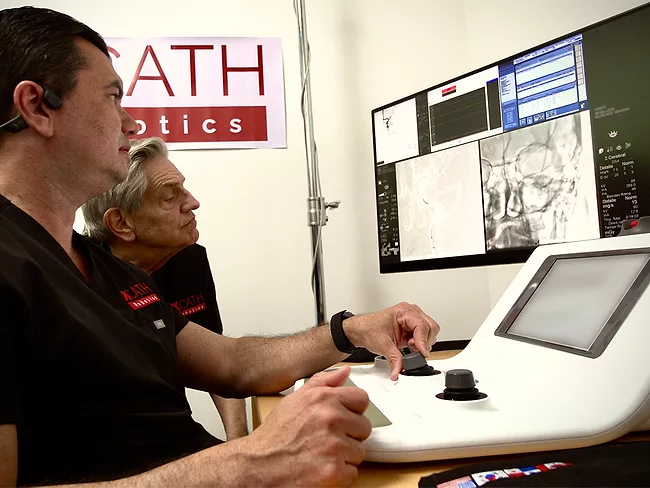
As robotic-assisted surgery platforms increasingly demonstrate that they can perform telesurgery safely, the question now is how soon remote operations will become part of routine clinical care. Eduardo Fonseca, CEO of Xcath Robotics Inc., reckons that within a decade the company’s Iris Surgical Robotic System could be in widespread use.
In 2025, the momentum behind robotic-assisted surgical systems continued to accelerate on the back of increasing demand for minimally invasive procedures. In many parts of the world, these technologies are reshaping surgical procedures by improving precision and efficiency through high resolution imaging, AI and refined instrument control. This is resulting in fewer complications, faster recovery and improved patient outcomes.
Intuitive Surgical Inc. strengthened its position as the market leader in robotic-assisted surgery in 2025 on the back of increasing demand for minimally invasive procedures. Intuitive’s da Vinci system is seeing robust growth in procedures and installations, fueling increased revenues.
The U.S. FDA’s clearance of Medtronic plc’s Hugo robotic-assisted surgery (RAS) system is certainly a boon for the company which is betting on the unit to be a key growth driver. While the soft tissue robotics market is dominated by Intuitive Surgical Inc.’s da Vinci system, the space is growing, and Medtronic has the scale, resources and market presence to make headway but there are also a plethora of smaller, versatile and cost-effective systems looking for a piece of the pie.
Patent litigation doesn’t always create outlandish damages awards but when it does, the outlandishness typically trends toward inordinately large sums. This was decidedly not the case in the Federal Circuit hearing in a patent lawsuit pitting Intuitive Surgical Inc., of Sunnyvale, Calif., against Rex Medical LP, of Conshohocken, Pa., given the damages awarded to Rex amounted to a mere $1.
Medtronic plc expects its Hugo robotic-assisted surgery system to be a key growth driver, especially when it receives U.S. FDA approval. Already approved for use in Europe, Medtronic recently received CE mark for the Ligasure technology to be used with the Hugo RAS system, expanding its capabilities for gynecologic, general and urologic procedures, across the region.
First quarter earnings reports from Edwards Lifesciences Corp., Intuitive Surgical Inc. and Boston Scientific Corp. support trends seen earlier: Larger med-tech companies expect substantial tariff hits, but also have confidence that they can absorb the impact with fairly minor adjustments.
Johnson & Johnson’s Medtech division reported the completion of the first cases in the clinical trial for the Ottava robotic surgical system. The cases mark the first clinical experience with the Ottava system, which has been a long time in development.
In the wake of the pandemic, many leading med-tech companies took steps to on-shore and near-shore manufacturing, a move that could protect significant numbers of players from the worst of the effects of the tariffs announced by the Trump administration last week.
Johnson & Johnson received U.S. FDA investigational device exemption to begin the pivotal clinical trial for the Ottava robotic surgical system. If the trial goes well, Ottava could pose a significant challenge to decades-long dominance of the robotic surgical market by Intuitive Surgical Inc.’s Da Vinci system.