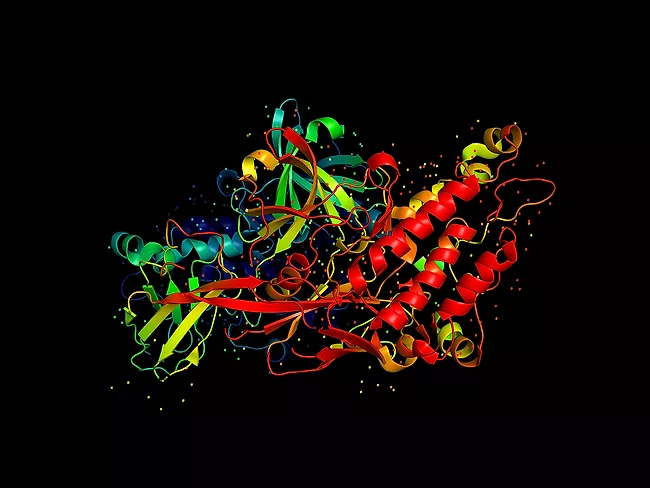
David Baker, Demis Hassabis and John Jumper share the 2024 Nobel Prize in Chemistry for their contributions to the science of protein structure. David Baker was awarded half the prize “for computational protein design,” according to the Royal Swedish Academy of Sciences. Hassabis and Jumper shared the other half “for protein structure prediction.”
David Baker, Demis Hassabis and John Jumper share the 2024 Nobel Prize in Chemistry for their contributions to the science of protein structure. David Baker was awarded half the prize “for computational protein design,” according to the Royal Swedish Academy of Sciences. Hassabis and Jumper shared the other half “for protein structure prediction.”
David Baker, director of the Institute for Protein Design at the University of Washington School of Medicine, is a pioneer in protein design. His contributions have been recognized with countless awards, and now, a place among the 2024 Clarivate Citation Laureates. Baker’s lab has developed several open-source software applications for nanotechnology and biomedicine. With these methods, scientists build new proteins that bind to drug targets and block them or activate cellular signals.
As the average cost of new drug R&D continues to skyrocket, the perception around using artificial intelligence (AI) as a tool to boost drug discovery is changing. “Developing new AI-based drugs is a difficult task, not only for Korea but also for countries with leading AI technology,” Hyeyun Jung, principal researcher of Korea Health Industry Development Institute’s Center for Health Industry Policy, told the audience at the Bio Korea meeting on May 9. “But there is a change in perception; [namely that] applying AI to new drug development is not an option but a necessity.”
As the average cost of new drug R&D continues to skyrocket, the perception around using artificial intelligence (AI) as a tool to boost drug discovery is changing. “Developing new AI-based drugs is a difficult task, not only for Korea but also for countries with leading AI technology,” Hyeyun Jung, principal researcher of Korea Health Industry Development Institute’s Center for Health Industry Policy, told the audience at the Bio Korea meeting on May 9. “But there is a change in perception; [namely that] applying AI to new drug development is not an option but a necessity.”
A company launched by Alphabet Inc.’s Deepmind in 2021, Isomorphic Labs Ltd., entered its first biopharmaceutical partnerships to discover small-molecule therapeutics with Eli Lilly and Co. and Novartis AG in deals worth $1.75 billion and $1.24 billion, respectively.
Artificial intelligence (AI) is in full development, and advances are already used in many fields, including medicine. In oncology, these tools can identify a tumor in an image with 99% accuracy. But they can also miss it if the algorithm was not developed with the right data or the correct decisions. The 2023 European Society for Medical Oncology (ESMO) Congress brought together in Madrid doctors and deep learning experts to discuss the challenges and advances of AI in this area. And what’s better than asking an AI what its trainer has told it about AI?
Researchers have identified a druggable pocket on the phosphatase Wip1, which regulates the tumor suppressor TP53 as well as DNA damage repair proteins. The work, which was published in Frontiers in Molecular Biosciences on April 18, 2023, by researchers from the University of Pennsylvania, could lead to therapeutics targeting Wip1. And the computational deep learning methods used to identify the pocket are broadly useful for identifying what the authors call “cryptic” pockets.
The artificial intelligence-first approach to drug discovery may be boosting productivity but has also exposed the fact that in silico design can only go so far. At some point it will be necessary to revert to the conventional method and synthesize a protein and do an experiment. Now newco Adaptyv Bio aims to smooth this transition by applying cell-free systems and micro fluidics to enable proteins to be synthesized and validated at nano scale.
It is now possible to look up the 3D structure of every known protein following the latest release of Alphafold, an open database run in partnership by Deepmind, the London-based artificial intelligence company owned by Google parent Alphabet and the European Molecular Biology Laboratory’s European Bioinformatics Institute in Cambridge, U.K.