Fuzionaire Diagnostics Inc. has changed its name to Fuzionaire Theranostics Inc. to better reflect the company’s pipeline of paired fluorine-18 PET diagnostics and radioligand therapies to find and treat cancer.
Isotope Technologies Munich SE (ITM) raised $280 million to support the expansion of its broad targeted radionuclide therapies oncology pipeline. This equity investment round was led by Temasek holdings Pte Ltd. with participation from Blackrock Alternatives, Qatar Investment Authority, Nextech Invest Ltd., Athos KG and Carbyne Equity Partners GmbH.
The big idea behind radiopharmaceuticals is taking the hallmarks of two cancer therapies – radiology and chemotherapy – and merging them, and this is what makes the technology a disrupter.
The big idea behind radiopharmaceuticals is taking the hallmarks of two cancer therapies – radiology and chemotherapy – and merging them, and this is what makes the technology a disrupter.
GE Healthcare has introduced an all-digital PET/CT System featuring a new category of digital BGO (crystal-based gamma ray detection) employing a smaller crystal size to deliver greater spatial resolution than other digital scanners. Pitched at the European Association of Nuclear Medicine’s annual meeting in Barcelona on Oct. 16, Omni Legend was designed to accelerate scan times and has demonstrated, according to GE Healthcare global chief marketing officer Sonia Sahney, “impressive small lesion detectability.”
Researchers from the University of Saskatchewan have developed a novel theranostic candidate, [67Cu]EB-TATE, as an alternative to [177Lu]DOTATATE, for the imaging of gastroenteropancreatic neuroendocrine tumors (GEP-NET). EB-TATE, which is a derivative of octreotate with evans blue (EB), was radiolabeled with electron linear accelerator-produced 67CuCl2.
Radiopharm Theranostics Ltd.’s phase II F-18 Pivalate positron emission tomography trial in brain metastases saw positive results with high uptake regardless of the origin of primary tumors, showing that Pivalate could be used to monitor brain metastases.
The suboptimal metabolic stability of radiolabeled gastrin-releasing peptide receptor (GRPR) antagonists has been a hindering factor of these promising theranostic candidates for prostate cancer. Uppsala University researchers have recently reported the development of [111In]DOTAGA-PEG-2-SAR11-RM-26, after replacement of Gly11 by Sar11 in the peptidic chain.
Radiopharm Theranostics Ltd.’s phase II F-18 Pivalate positron emission tomography trial in brain metastases saw positive results with high uptake regardless of the origin of primary tumors, showing that Pivalate could be used to monitor brain metastases.
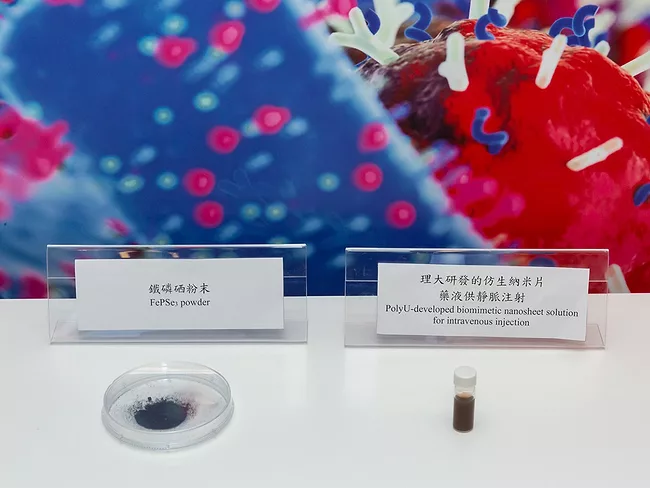
Researchers from The Hong Kong Polytechnic University (PolyU) said they have used two-dimensional nanosheets (FePSe3) to develop a biomimetic nanosheet that can monitor tumor development, treat tumors and monitor the treatment progress in real-time. With positive results from mice, the team hopes to further test it on larger animals, then move on to clinical studies.