Minneapolis-based Smiths Medical Inc., recalled two entries in the company’s CADD-Solis line of ambulatory infusion pumps due to problems with the preloaded software.
It appears that the expression no news is good news is especially applicable to intra-aortic balloon pumps (IABPs), thus the class I recall of Arrow International devices was bad news for patients.
A recent hearing in the U.S. House of Representatives highlighted some of the issues Congress has with the agency’s performance, but there were questions as well about the FDA’s statutory authorities. One of these is the lack of statutory authority to require a recall for prescription drugs as well as the deadline for notifying the agency of device recalls, both of which are areas of legislative interest on the part of Congress.
Vyaire Medical Inc., of Mettawa, Ill., reported a class I recall of its Twin Tubes devices, which are used in the collection of air samples during cardiopulmonary exercise testing. The recall was prompted by the risk that the device nozzle will separate during patient use and potentially result in choking, although the FDA said there have been no reports of adverse events in connection with the problem.
The U.S. FDA announced several new and updated recalls recently, including a new recall of incubators made by Wipro GE Health Pvt. Ltd., of Bangalore, India, which may be subject to an increased risk that the infant may fall out of the system.
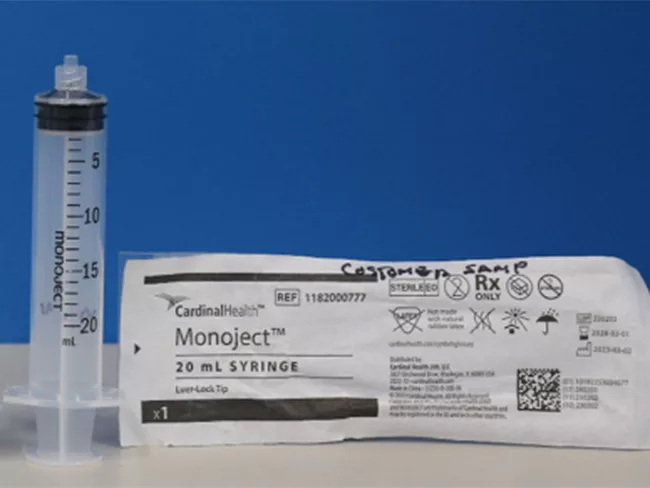
The U.S. FDA advises health care providers (HCPs) to avoid using Monoject syringes distributed by Cardinal Health with syringe pumps or patient-controlled analgesia (PCA) pumps because of incompatibilities between the Monoject interface and the pumps.
Device recalls pop up with no regard to human appreciation for seasonality, and thus it was that recalls involving three major medical device makers emerged as the steamy month of July gave way to the arid, oppressive swelter of August. These recalls affected more than 7,500 units of the Trusignal pulse oximeter by GE Healthcare Technologies Inc., nearly 23,000 units of the Sigma Spectrum and Spectrum IQ infusion pumps by Baxter Healthcare Corp., and an unspecified number of units of the Carina ventilator by Drägerwerk AG, all of which adds a little more than the usual heat to the device industry’s dog days.
The U.S. FDA’s 510(k) program is yet again under assault, this time from the authors of a Jan. 10 article in the Journal of the American Medical Association (JAMA). The authors’ primary point seems to be that any 510(k) devices that recite a predicate that is the subject of at least three recalls are themselves more likely than average to be the subject of a recall, although there was no discernible association between recall status and technological differences between the predicate and the follow-on devices.
Getinge AB reported that intraortic balloon pumps (IABPs) manufactured by its Datascope subsidiary are in short supply following a recall of some of these devices in 2019. Getinge said manufacturing of units and parts is proceeding at the maximum pace allowed by supply chain volatility and recommended that hospitals facing shortages contact other nearby hospitals in the event of a lack of device availability.
The U.S. FDA posted an update to the ongoing recall of respirators and positive airway pressure devices by Philips Respironics Inc., a subsidiary of Amsterdam-based Royal Phillips NV, which are associated with more than 21,000 medical device reports (MDRs) between Aug. 1 and Oct. 31, 2022. However, these MDRs are also associated with 91 patient deaths, which while they cannot be attributed directly to these devices, are nonetheless a stain on the reputation of the company’s products going forward.