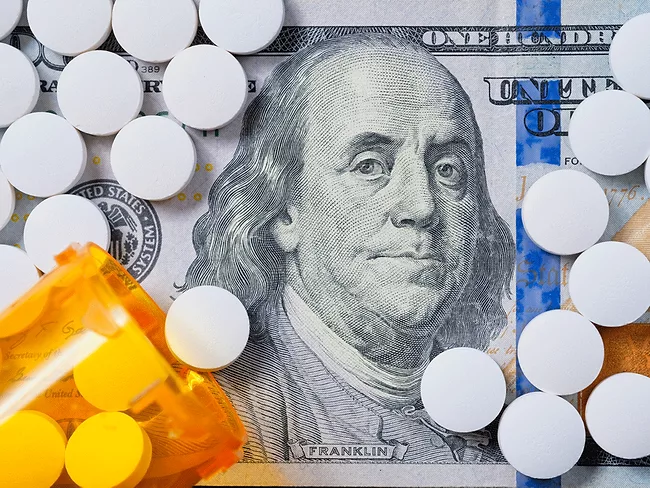
Nearly $3.8 billion was earned by Novo Nordisk A/S and Eli Lilly and Co. in the third quarter for their glucagon-like peptide-1 (GLP-1) drugs to treat obesity. Novo’s GLP-1 drug, Wegovy (semaglutide), approved by the U.S. FDA in June 2021, had sales of DKK17.3 billion (US$2.5 billion), while Lilly’s Zepbound (tirzepatide), which is a GLP-1 and glucose-dependent insulinotropic polypeptide dual agonist FDA-approved in November 2023, posted sales of $1.26 billion for the quarter.
The U.S. Court of Appeals for the Fifth Circuit revived the Pharmaceutical Research and Manufacturers of America’s (PhRMA) constitutional challenge to the Medicare price negotiations, sending it back to a federal court in Texas for a do-over.
Two tales of one law were told Sept. 17 as the U.S. Senate Finance Committee discussed the successes and failures of the health care provisions included in the Inflation Reduction Act (IRA) as members looked toward different sequels.
The ever-contentious issue of drug pricing creates a tug-of-war between biopharma’s innovation machine and the general population’s need for accessible and affordable drugs. BioWorld has covered the issue of drug pricing from insulin caps and the early days of the IRA to failed legal challenges and the recent rollout of the Centers for Medicare & Medicaid Services’ negotiated prices. Read our collection of 2024 stories.
The U.S. Department of Health and Human Services (HHS) is 6-1 so far in blocking court challenges to the Medicare price negotiation program mandated by the Inflation Reduction Act (IRA). The department’s latest victory came July 31 when a federal district judge in New Jersey tossed a complaint filed by Novo Nordisk A/S, citing a lack of jurisdiction on the court’s part and the company’s lack of standing.
The U.S. government chalked up another win April 29 against the constitutional challenges to the Inflation Reduction Act’s provision mandating direct Medicare price negotiations for selected prescription drugs.
In what was more of a campaign speech accompanied by frequent chants of “four more years,” U.S. President Joe Biden loaded the annual State of the Union address March 7 with what sounded like campaign promises for a second term. Among those promises were calls to Congress to expand the prescription drug price provisions of the 2022 Inflation Reduction Act.
The queue of lawsuits challenging the constitutionality of the U.S. Inflation Reduction Act’s (IRA) prescription drug price negotiations continues to grow. Novartis AG is the latest drug company, but probably not the last, to join the line. It filed its challenge in federal court in New Jersey Sept. 1, a few days after the Centers for Medicare & Medicaid Services included the company’s heart failure drug, Entresto (sacubitril and valsartan), on its list of the 10 drugs subject to the first round of IRA negotiations.
In response to the Biden administration announcing on Aug. 29 the first 10 medications up for price negotiations with the Centers for Medicare & Medicaid Services as part of the Inflation Reduction Act of 2022, U.S. Senate and House Republicans are firing back, calling the imposed “price-controls set by Washington bureaucrats” part of a scheme that “will lead to higher prices for new drugs coming to market, stifle the development of new cures and destroy jobs,” ultimately driving up costs for seniors.