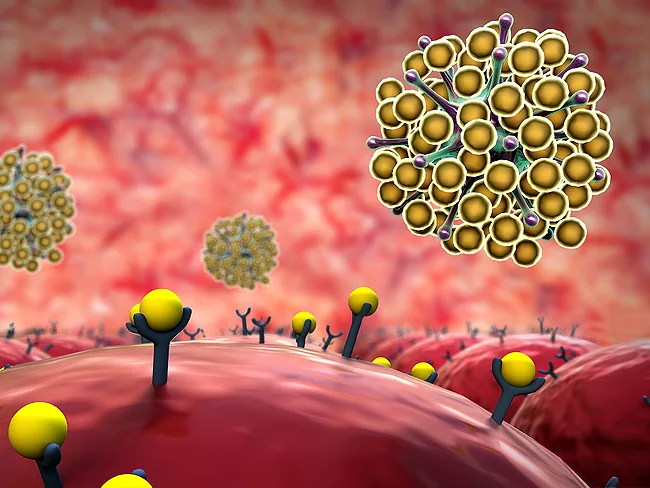
University of Regensburg has described water-soluble FLT3 (FLK2/STK1) inhibitors and their prodrugs reported to be useful for the treatment of acute myeloid leukemia (AML).
The development of resistance and relapse during the blast phase of chronic myeloid leukemia poses a challenge in the management of this pathology, with half of the cases accounting for FLT3 pathway activation that, in turn, contributes to tyrosine kinase inhibitor resistance.
Researchers at Biodol Therapeutics SAS, Centre National de la Recherche Scientifique, INSERM and Université de Strasbourg have divulged new n-heteroarylbenzamide derivatives acting as FLT3 (FLK2/STK1) inhibitors and reported to be useful for the treatment of pain.
Kurome Therapeutics Inc. along with the Cincinnati Children’s Hospital Medical Center and U.S. Department of Health and Human Services have patented interleukin-1 receptor-associated kinase (IRAK) and/or FLT3 (FLK2/STK1) inhibitors reported to be useful for the treatment of cancer, autoimmune disease and inflammatory disorders.
Bridge Medicines LLC has divulged protein ENL (MLLT1; YEATS1) and/or FLT3 (FLK2/STK1) inhibitors potentially useful for the treatment of acute lymphocytic leukemia and acute myeloid leukemia.
One-third of patients with acute myeloid leukemia (AML) present mutations in the FMS-like tyrosine kinase 3 (FLT3) gene. Several first- and next-generation FLT3 inhibitors are currently being used in AML management, but there is a need for new options able to achieve complete and sustained FLT3 signaling suppression.
Cincinnati Children’s Hospital Medical Center has identified IL-1 receptor-associated kinase (IRAK) and/or FLT3 (FLK2/STK1) inhibitors reported to be useful for the treatment of cancer, autoimmune disease and inflammatory disorders.
About 30% of patients with acute myeloid leukemia (AML) harbor mutations in the gene encoding receptor-type tyrosine-protein kinase FLT3 in the form of internal tandem duplication (ITD) or mutations in the tyrosine kinase domain.
A Pelemed Co. Ltd. patent details new indirubin derivatives acting as inhibitors of FLT3 (FLK2/STK1) and/or proto-oncogene tyrosine-protein kinase receptor Ret (RET; CDHF12; PTC) and its mutants. They are reported to be useful for the treatment of acute myeloid leukemia.

.webp?height=488&t=1670008838&width=650 "Acute myeloid leukemia")