In a deal that could be worth up to $1 billion for Suzhou Siran Biotechnology Co. Ltd. (Siranbio), GSK plc licensed exclusive worldwide rights to the siRNA oligonucleotide SA-030, which has recently entered phase I trials for cardiometabolic disease.
Curacle Co. Ltd. inked a potential $1.07 billion deal with U.S.-based “newco” Memento Medicines on May 10, granting the latter exclusive global rights to develop and commercialize preclinical TIE2/VEGF-directed bispecific antibody MT-103 for retinal disorders.
In a deal potentially worth up to $15.2 billion, Jiangsu Hengrui Pharmaceuticals Co. Ltd. is joining efforts with Bristol Myers Squibb Co. to advance 13 early development programs in the fields of oncology, hematology and immunology. Shanghai-based Hengrui will hold exclusive rights in mainland China, Hong Kong and Macau, while Princeton, N.J.-based BMS will hold exclusive rights in the rest of the world. The deal includes four oncology/hematology assets from Hengrui, four immunology assets from BMS, and five assets that the two companies will jointly discover and develop.
Beone Medicines Ltd. gained an exclusive option to develop cancer immunotherapy HH-160 worldwide in a deal potentially worth more than $2 billion for Huahui Health Ltd., the developer of the trispecific antibody.
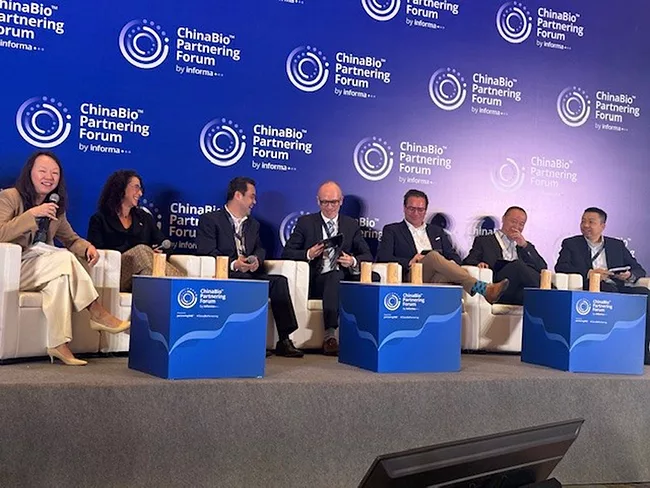
China’s investigator-initiated trial (IIT) system is increasingly being used to generate early human data in cell and gene therapies, and new changes that widen the pathway are expected to drive more multinational companies to conduct IITs in China, panelists said during the Chinabio Partnering Forum in Shanghai April 28-29.
Sun Pharmaceuticals Industries Ltd. will pay $11.75 billion cash to acquire Organon & Co. The transaction is expected to close in early 2027. The addition of Organon’s women’s health products, legacy drug brands and biosimilars are expected to boost Mumbai, India-based Sun’s global reach. The all-cash buy is also expected to relieve Jersey City, N.J.-based Organon of an $8.6 billion debt pile, accumulated after its debt-laden 2021 spinout from Merck & Co. Inc.
Biopharma deal value reached $79.22 billion in the first quarter (Q1) 2026, marking a strong start to the year and an increase of about 17% from $67.6 billion in Q1 2025 and similar to $78.93 billion in Q4 2025. The total is the highest first-quarter tally in recent years, and the highest quarter since Q4 2025 brought $80.65 billion.
China’s biotech ecosystem has crossed an inflection point, and Chinese biotechs are gaining leverage in dealmaking, executives from multinational companies said during the Chinabio Partnering Forum in Shanghai April 28.
Daiichi Sankyo. Co. Ltd. will begin a phased sale of its consumer health subsidiary, Daiichi Sankyo Healthcare Co. Ltd., to Suntory Holdings Ltd., as the Tokyo-based drugmaker sharpens its focus on oncology.
Biogen Inc. has consolidated full global rights to felzartamab through an $850 million deal with TJ Biopharma Co. Ltd. April 20, closing the chapter on a complex 10-year license saga.
 RSS
RSS