LONDON – Behold.ai Ltd. has secured U.S. FDA 510(k) approval for use of its Red Dot image recognition algorithm in the automatic diagnosis of life-threatening pneumothorax (collapsed lung). The product completes the analysis immediately, sending an alert to the radiologist as soon as an X-ray is taken. “It does in 30 seconds what would normally take up to 30 minutes,” said Simon Rasalingham, CEO of London-based Behold.ai.
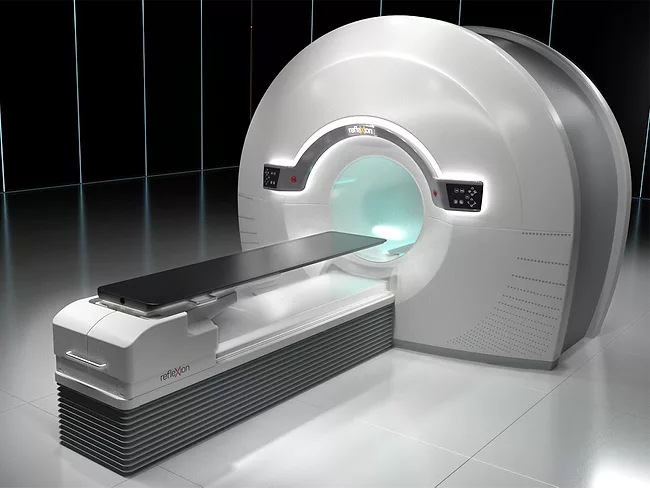
Hayward, Calif.-based Reflexion Medical Inc. has received the green light from the U.S. FDA to market its Reflexion X1 system for standard radiation therapy treatments. The company, which also is breaking new ground with the development of biology-guided radiotherapy (BgRT), aims to eventually bring multi-tumor precision radiotherapy to all stages of cancer treatment. The FDA cleared the Reflexion X1 for stereotactic body radiotherapy, stereotactic radiosurgery and intensity modulated radiotherapy. The clearance allows physicians to treat a single tumor with precise beam shaping and radiation dose delivery.
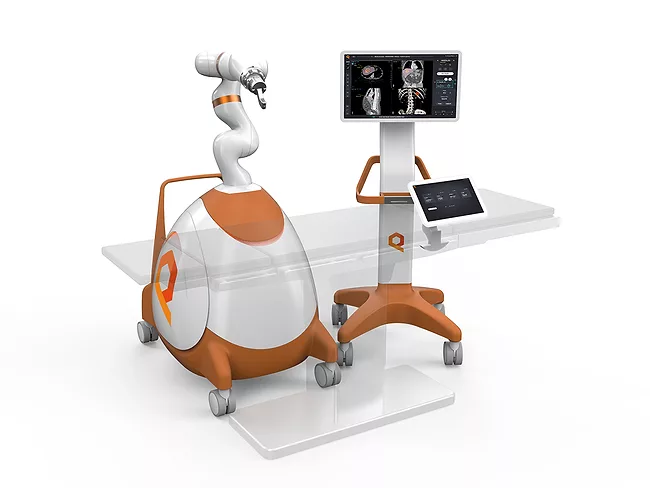
PARIS – Quantum Surgical SAS, of Montpellier, France, has been awarded development aid amounting to $2.25 million in grants and repayable loans from Bpifrance bank, as part of the French Deeptech program.
Novi, Mich.-based startup Delphinus Medical Technologies Inc. has been working for roughly a decade to introduce whole breast ultrasound tomography to improve breast cancer diagnosis and treatment.
Pharma has not gotten terribly serious yet about integrating digital health tools into clinical trials, let alone into their product offerings, despite the potential benefits they could offer when it comes to patient adherence, compliance and experience. Still, oncology giant Bristol-Myers Squibb Co. has made a small step in that direction by partnering with Paris-based digital therapeutics company Voluntis SA.
LONDON – Ibex Medical Analytics is preparing for commercial rollout in Europe after receiving CE-IVD marking for its artificial intelligence (AI) decision support system for automated interpretation of prostate cancer biopsies. Galen Prostate, trained on more than 60,000 samples from multiple institutions, is intended to give a second opinion on digitized slides, following initial assessment by a pathologist.
AI-based, digital pathology startup Proscia Inc. has partnered with the University of California at San Francisco (UCSF) to advance the practice of pathology via artificial intelligence (AI). The pair will start with prostate cancer and then plan to move on to validate approaches in several additional pathology subspecialties.
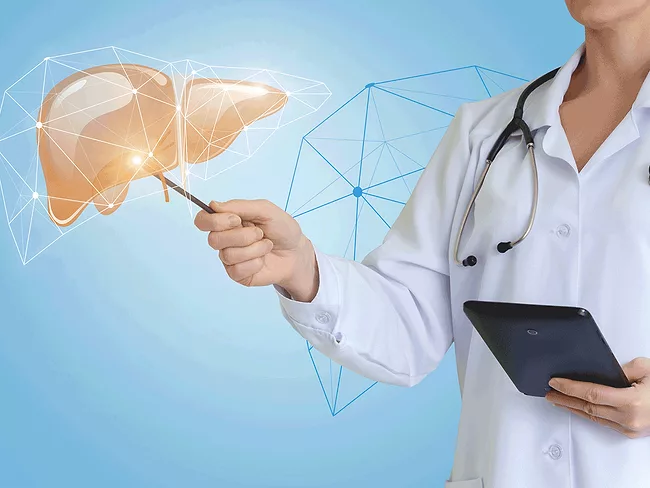
With an eye toward helping those with early stage hepatocellular carcinoma (HCC), Basel, Switzerland-based Roche Group has won a breakthrough device designation from the U.S. FDA for the Elecsys GALAD score. When combined with ultrasound, the Elecsys GALAD score aims to help provide more accurate information for clinicians to treat patients at an earlier stage.
Beyond every binary is a more complex reality. And so it is with driver and passenger mutations. The separation of tumor mutations into drivers and passengers underpins much progress in the development of targeted therapies.
Waveguide Corp. has launched the first portable, battery-powered nuclear magnetic resonance (NMR) device, Waveguide Formμla, offering rapid, on-site screening and diagnostics. The Cambridge, Mass.-based startup is looking to advance the product for use in detecting infectious diseases and cancer.
 RSS
RSS