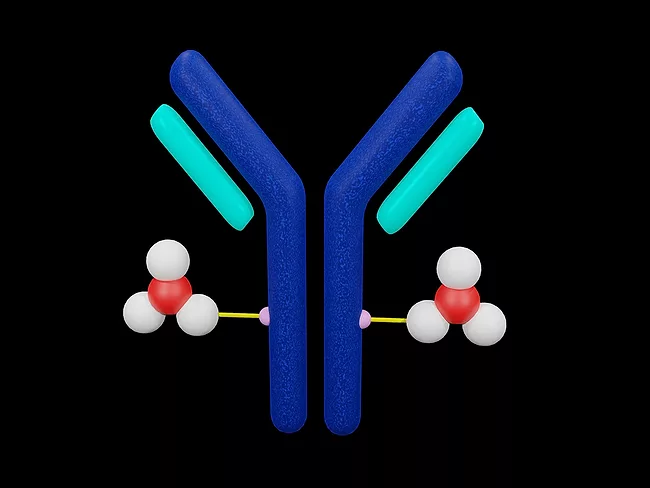
Myricx Bio Ltd. has closed the largest series A for a European biotech this year, raising £90 million (US$115.4 million), to take forward antibody-drug conjugates based on novel payload chemistry.
Myricx Bio (Myricx Pharma Ltd.), a spin out from Imperial College London and the Francis Crick Institute, has closed a series A financing raising £90 million ($114 million) to support its work focused on the discovery and development of a novel class of payloads for antibody-drug conjugates (ADCs).
Residual leukemic stem cells (LSCs) are leukemia relapse-initiating cells that mediate treatment resistance in response to therapy stress. Different from normal hematopoietic stem cells (HSCs), both blasts and LSCs express T-cell immunoglobulin mucin-3 (TIM-3) on the surface.
A new approach against non-small-cell lung cancer (NSCLC) has combined immunotherapy with molecularly targeted therapy to activate the immune response and inhibit oncogenic pathways, which prevented tumor progression and eliminated cancer cells. Brigham and Women’s Hospital scientists have developed nanoparticles loaded with antibody conjugates that could deliver large amounts of treatment to the tumor tissue. This new strategy could improve the results of conventional immunotherapy in these patients and reduce toxicity of existing treatments.
Day One Biopharmaceuticals Inc. has entered into an exclusive licensing agreement with Mabcare Therapeutics for MTX-13, a novel antibody-drug conjugate (ADC) targeting protein-tyrosine kinase 7 (PTK7). Under the agreement, Day One has exclusive rights to develop, manufacture and commercialize MTX-13 (now DAY-301), worldwide, excluding Greater China.
Santa Ana Bio Inc. has emerged from stealth with $168 million in combined series A and B funding and a focus on developing targeted therapies for patients with autoimmune and inflammatory diseases.
Indupro Inc. has announced a $85 million series A financing to support its work on precisely defining the spatial proximity of proteins on the surface of cells with high therapeutic potential across a broad range of indications and applications, including for the treatment of cancer and autoimmune diseases.
Bivictrix Therapeutics plc’s BVX-001, a first-in-class Bi-Cygni bispecific antibody-drug conjugate (ADC) for the treatment of acute myeloid leukemia (AML), has demonstrated a favorable toxicity profile in an industry standard toxicology model.
Shanghai Fudan-Zhangjiang Bio-Pharmaceutical Co. Ltd. has received IND clearance in China by the National Medical Products Administration (NMPA) to conduct a phase I trial of its antibody-drug conjugate (ADC) FZ-AD005 for advanced solid tumors.
 RSS
RSS