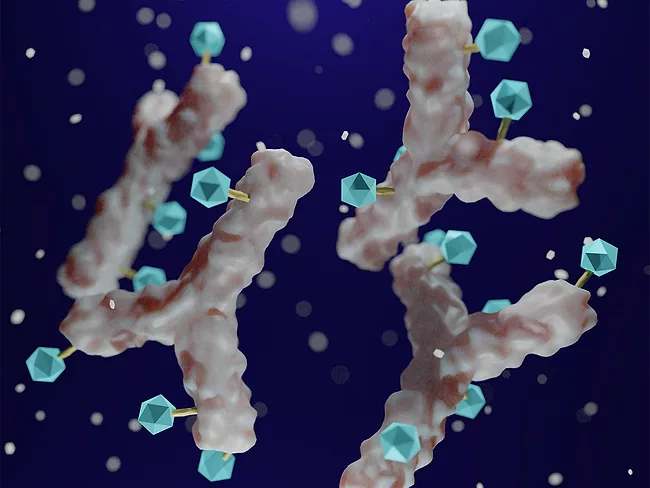
Haisco Pharmaceutical Group Co. Ltd. has disclosed antibody-drug conjugates consisting of antibodies covalently linked to antitumor drugs through a linker reported to be useful for the treatment of cancer.
Crescent Biopharma Inc. has announced regulatory clearances of IND applications for CR-001 (SKB-118), a PD-1 x VEGF bispecific antibody, and CR-003 (SKB-105), an integrin β-6 (ITGB6)-targeted antibody drug-conjugate (ADC), both being developed for the treatment of advanced solid tumors.
Ernexa Therapeutics Inc. has successfully completed a pre-IND meeting with the FDA, setting a pathway toward submitting an IND and initiating a first-in-human trial for the treatment of ovarian cancer, expected in the second half of this year.
Innolake Biopharm (Hangzhou) Co. Ltd. has disclosed antibody-drug conjugates comprising bispecific antibodies covalently bound to exatecan through a linker reported to be useful for the treatment of cancer.
Hainan Simcere Pharmaceutical Co. Ltd. has disclosed antibody-drug conjugates comprising a glycoengineered antibody covalently linked to a cytotoxic drug through a linker reported to be useful for the treatment of cancer.
The receptor tyrosine kinase-like orphan 1 (ROR1) is a transmembrane protein expressed during embryonic development. Moreover, it is highly expressed on the surface of several cancer cell types, including B-cell malignancies and solid tumors such as triple-negative breast cancer (TNBC). Researchers from The University of Queensland and collaborating institutions recently reported the development of a single-chain fragment variable (scFvs) specifically targeting the membrane proximal region of ROR1 rather than the Ig-like domain, aiming to reduce cross-reactivity with other surface proteins expressed in normal tissues.
Shanghai Henlius Biotech Inc. has announced acceptance of IND applications by China’s National Medical Products Administration (NMPA) for three differentiated candidates for the treatment of solid tumors.
Over the course of the year, and continuing into the latest scientific meetings, an extraordinary breadth of new antibody-drug conjugate (ADC) designs was reported, with innovations spanning targets, linkers, payloads, conjugation chemistries and overall architectures. Once defined by a simple “one target, one payload” model, the field is lately expanding into a more versatile and diverse therapeutic space.
Hanx Biopharmaceuticals Inc. has identified antibody-drug conjugates (ADCs) consisting of an antibody targeting TRBV12 covalently linked to cytotoxic drugs through linkers reported to be useful for the treatment of T-cell leukemia and T-cell lymphoma.
Shenzhen Grit Biotechnology Co. Ltd. and Shanghai Vitalgen Biopharma Co. Ltd. recently presented their work to develop and evaluate a novel anti-CD19 in vivo CAR T candidate, named GT-801.

 RSS
RSS