Palo Alto, Calif.-based Varian Medical Systems Inc. has won the U.S. FDA’s nod for its Ethos therapy, an artificial intelligence (AI)-driven holistic solution that is aiming to transform cancer care. This solution is designed to deliver an entire adaptive treatment in a typical 15-minute slot and is intended to put the patient at the center of care, noted Chris Toth, president of Varian Oncology Systems.
Brisbane, Calif.-based Caption Health Inc. received good news from the U.S. FDA, which has given a thumbs up to Caption Guidance. This software aims to assist medical professionals in the acquisition of cardiac ultrasound images and uses artificial intelligence (AI) to provide real-time guidance.
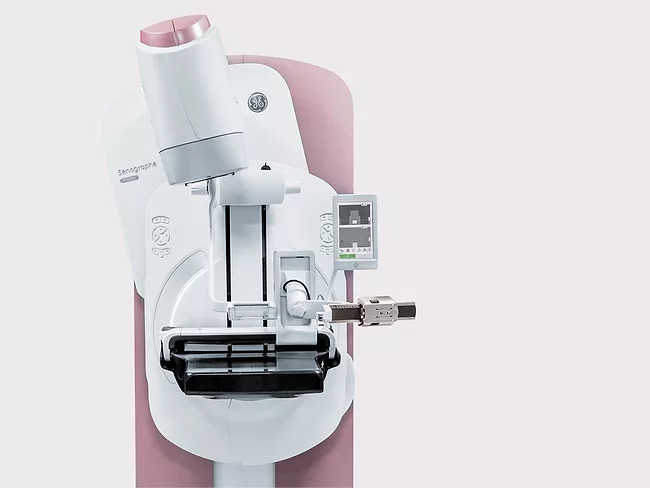
PARIS – The European mammography division of GE Healthcare Inc., based in Buc, France, has just performed the first breast biopsy guided by angiomammography, using the Pristina Serena biopsy robot on a patient at the Gustave Roussy Institute in Villejuif, France.
SANTA CLARA, Calif. – Translating novel technology into the care delivery system is not easy, according to Maulik Majmudar, medical officer at Bellevue, Wash.-based Amazon.com Inc. In fact, he said at the Precision Medicine World Conference that “it’s a hot mess.” In his presentation, Majmudar spoke about the classic barriers that prevent technologies from getting adopted at scale in a timeline that's usually feasible for early- and mid-stage startups – and even for large companies – and developing strategies to overcome those challenges.
HONG KONG – South Korean-based med-tech Lunit Inc., of Seoul, has secured ₩30 billion (US$25.6 million) in series C funding. Founded in 2013, the Korean company has raised $50 million so far. Lunit’s corporate value was evaluated at as much as ₩200 billion as of the fundraising.
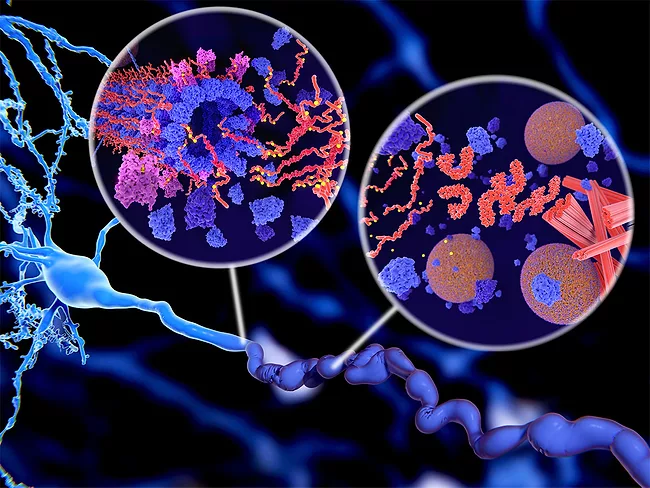
Amyloid and tau proteins are both involved in the disease pathology of Alzheimer’s disease. The diagnostic and treatment research focus has long been on amyloid, which has proven almost entirely fruitless after decades of effort. But tau is becoming better understood, as investigational tau imaging agents offer the ability to visualize its presence in the brain.
Israeli startup Zebra Medical Vision Ltd. has partnered with Johnson & Johnson’s Depuy Synthes to develop artificial intelligence (AI)-based algorithms to reduce the costs and radiation risks associated with imaging to prepare for orthopedic surgery.
TORONTO – “I don’t want this to die in the lab. We’re putting a lot of effort into this and we have to commercialize it.” With those words Oleksandr Bubon, chief technology officer of Thunder Bay, Ontario-based startup Radialis Inc., in 2016 reported ambitious plans for an imaging device that detects early stage cancer tumors in the densest breast tissue. Not only will its novel “gapless” design prevent radiation needed to treat cancer cells from escaping, a common problem in conventional positron emissions tomography (PET), its manufacture and commercialization starts here in a northern Ontario city of just over 110,000 people.
Orthogrid Systems Inc., of Salt Lake City, has received a green light from the U.S. FDA for the latest application on its intraoperable PhantomMSK platform, this one for use in orthopedic trauma cases. The new PhantomMSK Trauma application, which Orthogrid plans to formally roll out next spring, joins currently available applications for total hip and hip preservation. The Trauma application is an orthopedic surgical software that helps surgeons achieve and confirm the alignment of bone fractures and improves intraoperative efficiency via artificial intelligence-trained and augmented reality-based decision support and assistance for the placement of surgical instruments.
As part of newly announced collaborations with Cleveland-based Viewray Inc., Elekta AB assumed a 9.9% stake in the company, and Medtronic plc also made a minority investment. The company's largest shareholder, Fosun International Ltd., also led the round. "In total, the company raised approximately $139 million, net of fees," Viewray President and CEO Scott Drake told BioWorld MedTech.
 RSS
RSS