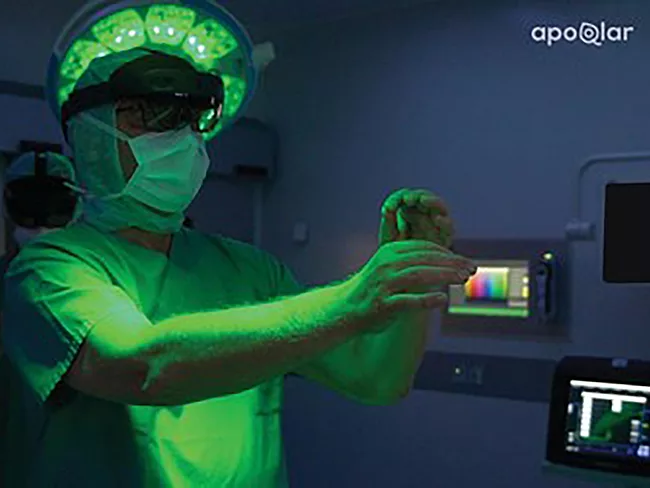
Apoqlar GmbH received a green light from the FDA for its VSI Holomedicine, a mixed reality software enabling surgeons to plan procedures in an immersive 3D experience. The company expects to release the technology for clinical use in the U.S. in the second quarter of 2023.
Getinge AB reported that intraortic balloon pumps (IABPs) manufactured by its Datascope subsidiary are in short supply following a recall of some of these devices in 2019. Getinge said manufacturing of units and parts is proceeding at the maximum pace allowed by supply chain volatility and recommended that hospitals facing shortages contact other nearby hospitals in the event of a lack of device availability.
Ricoh USA Inc. recently received U.S. FDA clearance for craniomaxillofacial (CMF) and orthopedic patient-specific anatomic modeling technology, using 3D printing technology developed by Eden Prairie, Minn.-based Stratasys Inc. for patient-specific representations of tissue and bone. The Ricoh 3D for Healthcare platform is described as an end-to-end workflow solution for designing and producing 3D-printed anatomic models for the mouth, jaws, face, skull and other CMF structures.
The U.S. FDA reported that the post-approval study (PAS) for the Impella RP by Abiomed Inc. of Danvers, Mass., demonstrated that the device performed well for patients who would have been eligible for the pivotal study, providing a 69.7% survival rate at 30 days after device explant.
At the recent Clinic Trials on Alzheimer’s Disease (CTAD) conference in San Francisco, Regenlife SAS presented the design for its Light4life study examining the therapeutic efficacy of the RGn600 device. This trial on more than 100 subjects will evaluate the cognitive impacts of new photobiomodulation technology.
Ironically, one of the casualties of the COVID-19 pandemic is an overdue review and revision of U.S. dual use research of concern (DURC) policies, as well as the Department of Health and Human Services’ Potential Pandemic Pathogen Care and Oversight guidance. Consequently, several senators are asking the White House to halt all ongoing and new viral gain-of-function and DURC studies in the life sciences that involve enhanced pathogens of pandemic potential.
The board of General Electric Co. officially approved the tax-free spin-off of the company’s health care business, which will be called GE Healthcare Technologies Inc. The new company will begin trading on the Nasdaq on Jan. 4, 2023, under the ticker symbol “GEHC.”
The ability to inexpensively predict events such as stroke and heart attack is something of a holy grail for cardiologists, and a new study presented at this year’s annual meeting of the Radiological Society of North American (RSNA) provides just that capability. A study of an algorithm developed to examine a single chest X-ray suggests that the data generated by the algorithm can be as effective in establishing the patient’s risk of these events as a standard approach that relies on information that isn’t always readily available to the clinician.
The U.S. FDA posted an update to the ongoing recall of respirators and positive airway pressure devices by Philips Respironics Inc., a subsidiary of Amsterdam-based Royal Phillips NV, which are associated with more than 21,000 medical device reports (MDRs) between Aug. 1 and Oct. 31, 2022. However, these MDRs are also associated with 91 patient deaths, which while they cannot be attributed directly to these devices, are nonetheless a stain on the reputation of the company’s products going forward.
Rapidai Inc. received U.S. FDA 510(k) clearance for release of intracranial hemorrhage (ICH) triage technology that reduces notification fatigue in doctors swamped by calls to treat hemorrhages that turn out to be false positives. In a test sample sent to the regulatory agency, the artificial intelligence (AI)-powered system demonstrated a sensitivity rating of 97% detecting genuine hemorrhages and 100% specificity for a false positive rate of zero.
 RSS
RSS