GE Healthcare Technologies Inc. gained full ownership of Nihon Medi-Physics Co. Ltd. after acquiring the remaining 50% stake from Sumitomo Chemical Co. Ltd. on March 31.
Alcon AG plans to acquire Lensar Inc. for up to $430 million in a transaction expected to close in the latter half of the year. The acquisition will add Lensar’s Ally robotic cataract laser treatment system, Streamline software technology and Lensar legacy laser system to Alcon’s cataract surgery portfolio and expand global access to Lensar’s femtosecond laser technology.
Med-tech M&A activity reached $10.35 billion in the first two months of 2025, with $4.81 billion in deals recorded in January and increasing to $5.55 billion in February. While total M&A value remained strong, the number of M&As dropped month-over-month, falling from 40 transactions in January to 19 in February, but still tracking with the 2024 average of nearly 30 per month.
The Vivani Medical Inc. combination appears to be over less than three years since its inception after the company reported plans to spin off Cortigent, the division that develops brain implants.
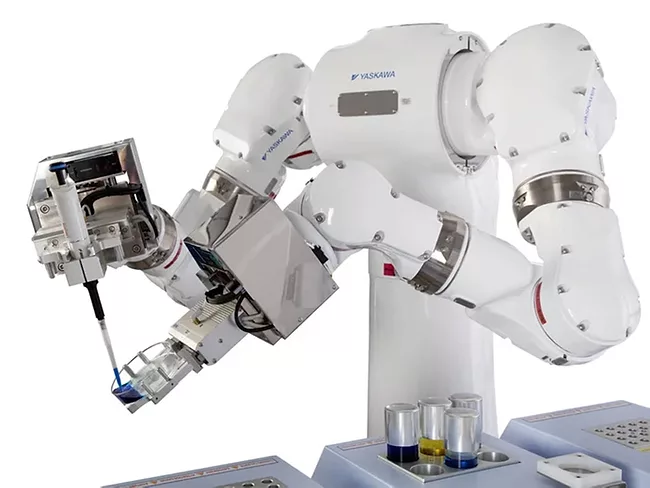
Astellas Pharma Inc. is setting up a joint venture with Yaskawa Electric Corp. to develop a new cell production platform using Yaskawa’s dual-arm humanoid robot called Maholo.
Repligen Corp. acquired 908 Devices Inc.’s desktop portfolio of four devices for bioprocessing process analytical technology (PAT) applications for $70 million in cash.
Ajax Health LLC, with backing from the $4 billion KKR Health Care Strategic Growth Fund II, and Boston Scientific Corp. launched a new business, Flowmod, to advance a system for treating heart failure developed by Boston Sci.
Boston Scientific Corp. agreed to acquire Sonivie Ltd., developer of a therapeutic intravascular ultrasound system for denervation to treat resistant hypertension, pulmonary hypertension and chronic obstructive pulmonary disease. On a 100% basis, the deal is valued at $600 million with $400 million up front and $200 million upon achievement of a regulatory milestone.
In a flurry of news releases on Feb. 27, Teleflex Inc. reported plans to buy the vascular intervention business of Biotronik SE & Co. for €760 million (US$791 million), said it intended to split into two separate public companies, floated a $300 million accelerated share repurchase program and reported the impending retirement of Chief Financial Officer Thomas Powell. The news sent the company stock down more than 20%.
The trend of corporate pruning in med tech continues with Solventum Corp.’s decision to sell its purification and filtration business to Thermo Fisher Scientific Inc. for $4.1 billion. The announcement follows two other big company splits already in 2025: Baxter International Inc.’s separation of its kidney unit as Vantive, bought by Carlyle Group Inc. for $3.8 billion, and Stryker Corp.’s planned sale of its spinal implants business to Viscogliosi Brothers LLC.
 RSS
RSS