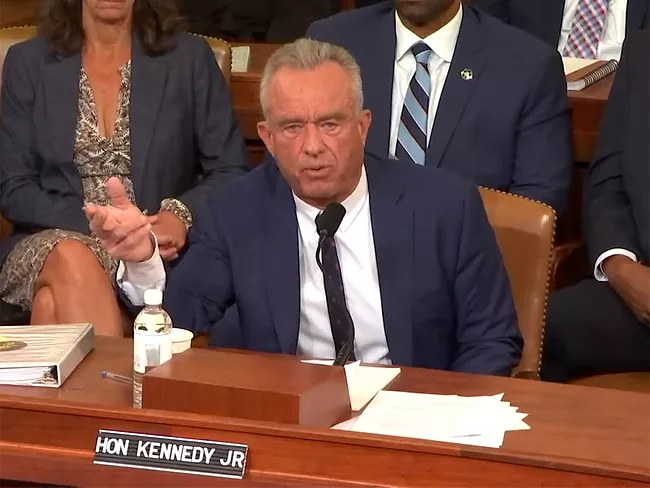
U.S. Health and Human Services (HHS) Secretary Robert Kennedy made his first stop April 16 on a congressional tour in support of President Donald Trump’s proposed fiscal 2027 budget, which would reduce discretional spending for HHS and its agencies by about 12%.
Despite key vacancies, ongoing staffing challenges and policy issues at the U.S. CDC, FDA and NIH, some of the regulatory churn that roiled those agencies in the first year of the second Trump administration is settling a bit, at least in terms of the number of executive orders (EOs) coming out of the Oval Office.
If a recent warning letter is anything to go by, the U.S. FDA could be using the 2013 Drug Supply Chain Security Act as another enforcement tool to shut down unauthorized suppliers by clamping down on the dispensers that purchase their unapproved drug products.
The U.S. FDA sent out a friendly reminder to more than 2,200 sponsors and researchers, associated with more than 3,000 clinical trials, who may be delinquent in disclosing the results of those studies on clinicaltrials.gov.
Amending his previous two-year-renewal of the standard charter for the U.S. CDC’s Advisory Committee on Immunization Practices (ACIP), Health and Human Services Secretary Robert Kennedy made monitoring adverse vaccine events a primary function of the committee and expanded its liaison membership to include organizations that have challenged vaccine safety.>
With three rare pediatric disease priority review vouchers (RPD PRVs) awarded just since the end of March, the nearly year-and-a-half lapse in the program’s reauthorization seems to have had little short-term impact. The three new vouchers bring the total RPD PRVs granted so far this year to seven – one more than the agency issued all last year and down two from the nine given in 2024.
In a decision that maintains the regulatory status quo, the U.S. FDA denied a petition from Harrison.ai to partially exempt certain diagnostic/detection AI devices from premarket review so long as the manufacturer has 510(k) clearance for a device in a similar category and a robust postmarket plan.
After more than a decade at the helm of the Pharmaceutical Research and Manufacturers of America (PhRMA), Stephen Ubl said he plans to step down as president and CEO of the trade organization at the end of the year.
Don’t like a court order? Sidestep it. That seems to be the idea behind U.S. Health and Human Services Secretary Robert Kennedy’s latest changes to his renewal of the charter for the CDC’s Advisory Committee on Immunization Practices (ACIP).
After nearly a year of threats and promises of a global biopharma tariff of 25% to 500%, U.S. President Donald Trump finally delivered it. In the name of national security, he imposed a 100% sector tariff on prescription drugs and their associated ingredients beginning in about four months for large manufacturers and six months for smaller companies.