
 RSS
RSS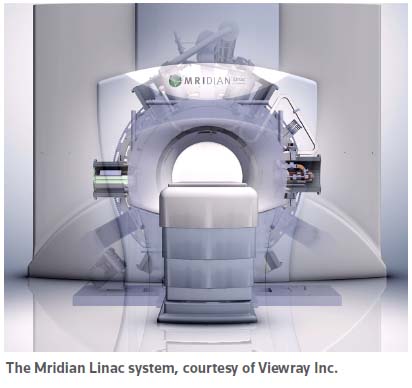
Viewray Inc. received FDA clearance for the Mridian Linac system, a device that allows clinicians to visualize in real time the movement of tumors and organs during radiation treatment. The Oakwood, Ohio-based company's technology, which also has CE mark approval, combines MRI guidance with linear accelerator radiation.
Viewray's president and CEO, Chris Raanes called the clearance a milestone for the company. First-generation Mridian technology, which uses cobalt-60 therapy for therapy, received FDA clearance back in 2012. (See Medical Device Daily, May 31, 2012.)
"We spent an awful lot of time explaining to the world why MRI is equivalent to cobalt sources," Raanes told Medical Device Daily. "Now we don't have to make that explanation any more. The [current generation] system will treat patients a lot faster and there will be a lot of advantages in the sharpness of the beam [as compared to the cobalt] therapy."
The cobalt radiation source has represented a large stumbling block to market acceptance for the first generation of the device due to several factors. The Department of Homeland Security regulates the use of cobalt, making it difficult for smaller centers to obtain the devices. Cobalt beams also suffer from the penumbra effect, which blunts the beam edges, lowers output and limits its use as a true stereotactic body radiation therapy machine and for head and neck cases.
The Mridian Linac features double focused beam-shaping technology, which provides the sharpest beam available and is ideal for more advanced SBRT procedures.
Analysts of the space have been praising the FDA clearance.
"Viewray stands at the cusp of introducing disruptive new technology in radiation oncology," said Suraj Kalia, an analyst with Northland Capital Markets.
Jason Wittes, an analyst with Aegis Capital Corp., said the clearance doesn't come as a "surprise" and that orders for the Linac, along with conversions of the old system, should pick up quickly.
"Our checks continue to show significant interest from the field for a Linac-based system with MRI guidance, which should support an elevated adoption ramp," Wittes said. "This sets up for a strong 2017 in orders."
The first two Mridian Linac systems in the U.S. are expected to be installed at Henry Ford Hospital in Detroit and Barnes-Jewish Hospital at Washington University in St. Louis.
Competition for Viewray is incredibly thin in the space. The company could possibly face competition from Elekta AB's Atlantic System. The Stockholm-based company partnered with Royal Philips NV to develop the MRI-linac guided technology. However, to even come close to competing with Viewray's Mridian Linac, the Atlantic System would need to have a significant reduction in size, Raanes said.
"My point of view is that they're going after a completely different market, and it's going to take years for them to catch up with anything that we have," Raanes told Medical Device Daily. "One of the key points of our technology is that not only do we have our clinic Linac, but our system is designed to fit into a regular-sized room."
Another potential competitor is Reflexion Medical Inc. The Hayward, Calif.-based company is working on a device that uses PET imaging to guide radiation therapy in real time. Reflexion said its device has the ability to treat multiple tumors in parallel.
"Viewray currently has six systems active in the field and a backlog of over $125 million [22 systems], representing a significant lead over its closest competitor Elekta, who has yet to treat a patient with its Atlantic system, and market leader Varian, who we believe will eventually have to respond given the widespread potential for the technology," Wittes said.
In addition to obtaining FDA approval, the company also reported 4Q16 results. Viewray had a net loss of $11 million for 4Q16 and $50.6 million for the full year.
The company has earnings per share of -25 cents vs. analyst consensus of -34 cents for the quarter.
Just last month, Puissance Capital Management led a $26.1 million private placement financing round that included common stock and warrants. The round, along with the FDA clearance should help put the company on a path to "ensuring liquidity before reaching sustained profitability in 2018," Wittes said.