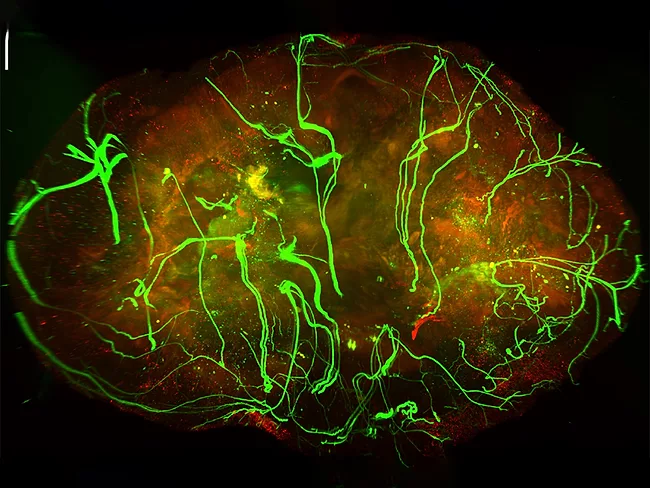
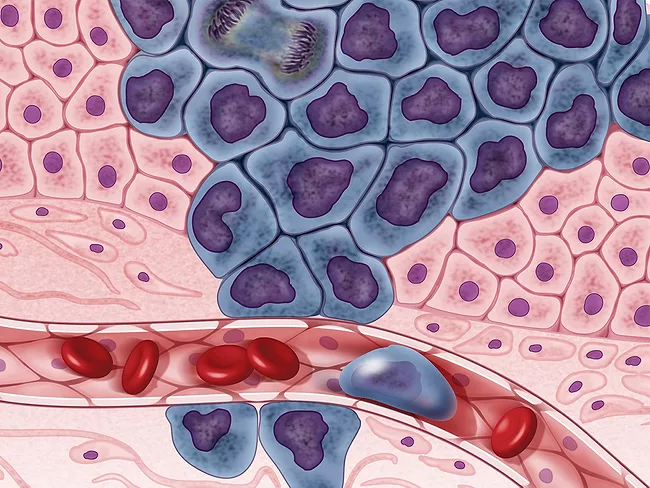
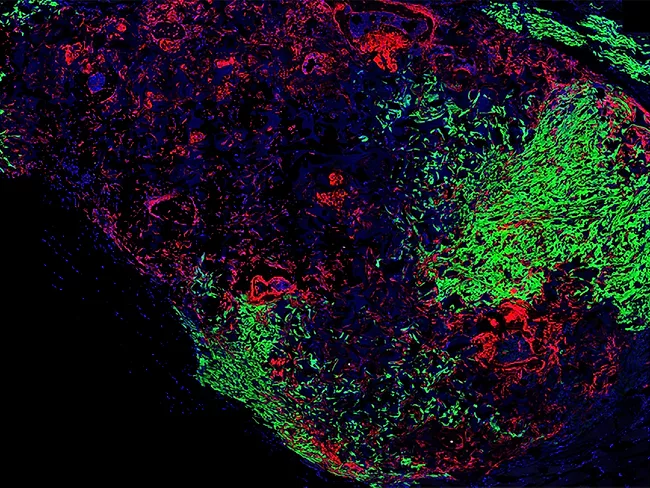
Innervation by the sympathetic nervous system is typically a boon to tumors. But researchers from Weill Cornell Medicine and colleagues have shown that in some cases, the relationship between tumors and the nervous system is more complex. Depending on context, innervation can either assist or obstruct tumor growth. “The nervous system typically has been considered as a driver of cancer growth, but here we’ve found that it can be a brake on cancer growth in some contexts,” said David Simon, an assistant professor of biochemistry and biophysics at Weill Cornell Medicine.
The National Institute of Allergy and Infectious Diseases (NIAID) has awarded a 5-year $20.8 million grant to a multi-institutional team led by Weill Cornell Medicine investigators for advanced preclinical development of a promising experimental HIV vaccine.
Mutations in the GTPase KRAS drive proliferation of many types of tumors, and daraxonrasib (RMC-6236), which inhibits various KRAS mutants, can slow growth of pancreatic and lung cancers. Researchers at City University of New York and Weill Cornell Medical College have demonstrated that it also showed effects in osteosarcoma models expressing mutated KRAS.
In recent years, immune checkpoint inhibitors have had great success in the treatment of advanced cancers, but often, they are only effective in a minority of patients. Researchers from Weill Cornell Medicine have discovered that the activation of the pentose phosphate pathway (PPP) in combination with standard immune checkpoint inhibitors resulted in enhanced antitumor efficacy both in vitro and in vivo.
The E4 variant of the APO gene, the R47H variant of the TREM2 gene, and female sex are three of the strongest risk factors for the development of Alzheimer’s disease (AD). By combining all three of them in a mouse model of tauopathy, researchers at Weill Cornell Medical School have identified microglial inflammation and senescence as processes that occurred more strongly in female mice as tauopathy developed.
Prior to this year’s Annual Meeting of the American Association for Cancer Research (AACR), it had been 14 years since metastasis had been the subject of a plenary session. So, the Tuesday session on “Evolution of the genome, microenvironment, and host through metastasis” had plenty of new insights to share.
Prior to this year’s Annual Meeting of the American Association for Cancer Research (AACR), it had been 14 years since metastasis had been the subject of a plenary session. So, the Tuesday session on “Evolution of the genome, microenvironment, and host through metastasis” had plenty of new insights to share.
Biopsies from up to 14% of patients with non-small-cell lung cancer (NSCLC) showing resistance to epidermal growth factor receptor (EGFR) tyrosine kinase therapy ascertain histologic transformation (HT) to SCLC, which is estimated to kill around 250,000 patients globally, every year. In a study published in Science on Feb. 9, 2024, researchers from Weill Cornell Medicine have dissected that complex process using a genetically engineered mouse model of pulmonary HT.
After an initial chemical screening, researchers at the University of Pennsylvania and Weill Cornell Medicine identified the Chk1/Chk2 dual inhibitor AZD-7762 among the strongest to induce insulin secretion in various assays.
Long bones, vertebrae and skull bones have distinct types of stem cells, and new insights into those stem cells could lead to new ways to treat both rare developmental disorders of skull formation and the all-too-common phenomenon of bone metastases. Scientifically, the work, which was published in two papers by Matthew Greenblatt and colleagues in Nature, adds to the increasing understanding of bone’s complexities. “Bone may serve as an endocrine organ that is secreting factors throughout the body,” Greenblatt said.