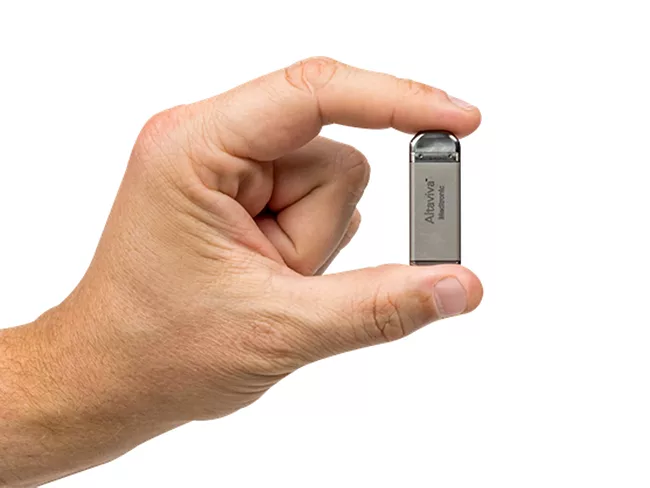
Medtronic plc received U.S. FDA approval for Altaviva, a minimally invasive implantable tibial neuromodulation device designed to treat urge urinary incontinence. Insertion near the ankle requires neither sedation nor imaging and patients walk out the clinic door with the device already activated.
Medtronic plc and Irvine, Calif.-based Axonics Inc. have been locked in a struggle over several patents in the past few years, but now Medtronic has shifted some of its effort from the U.S. courts to the executive branch.
Boston Scientific Corp. agreed to acquire neurostimulation company Axonics Inc. for $71 per share or $3.7 billion in total. Axonics focuses on stimulation of the sacral neve to treat overactive bladder and bowel dysfunction. It also offers a bulking agent to address stress urinary incontinence in women.
The deal is expected to close in the first half of 2024, pending approval of stockholders and regulators.
The inter partes review (IPR) process used to adjudicate patent disputes in the U.S. has had its share of critics, but ongoing patent litigation revolving around nerve stimulation technology between Axonics Inc., and Medtronic plc has disclosed another bone of contention in how IPRs are handled. The Court of Appeals for the Federal Circuit has ruled that a patent holder, Dublin-based Medtronic in this instance, can offer a new claim construction for its disputed patent once an IPR has been instituted, but said also that the Patent Trial and Appeal Board (PTAB) had erred in not allowing Axonics to respond to the new claim construction, sending the related IPRs back to the PTAB for another look.
Much of U.S. patent law jurisprudence still revolves around subject matter eligibility, but a new decision by the Court of Appeals for the Federal Circuit revisits the question of what constitutes obviousness in patent applications. The court remanded the case between Irvine, Calif.-based Axonics Inc. and Dublin-based Medtronic plc to the Patent Trial and Appeal Board (PTAB) after determining that the PTAB judge’s understanding of obviousness is “doubly infected by error” in a decision that seems to offer some much-needed clarity where obviousness is concerned.
Gilde Healthcare Partners BV raised €600 million (US$658 million) in capital commitments for a new investment fund which will be deployed into companies across Europe and the U.S active in digital healthcare, medical technology and therapeutics. The fund, ‘Venture&Growth VI’, will focus on investing in fast growing companies developing solutions for better care at lower cost.
Andera Partners led a $48.5 million series A financing round for Bioventrix Inc. which will allow the medical device company to complete its premarket approval (PMA) submission for the Revivent TC system. Andera joined Cormorant Asset Management and Squarepoint Capital as new investors in Bioventrix. Existing investors, Taglich Brothers Inc. and Richmond Brothers, also contributed to the fundraising.
Andera Partners closed its Biodiscovery 6 fund at €456 million (US$442 million). The venture capital firm will maintain its custom of allocating about two-thirds of the fund to biotechnology and one-third to medical devices and medical technology. The fund just edges past its target of €450 million. It is considerably larger than its immediate predecessor, Biodiscovery 5, which raised €345 million.
Axonics Inc. received FDA approval for its recharge-free sacral neuromodulation (SNM) implantable neurostimulator (INS) for bladder and bowel dysfunction. The F15’s primary cell requires no recharging or replacement for more than 15 years with normal use or 20 years at lower energy settings and the system is compatible with 1.5T and 3.0T full body magnetic resonance imaging scans.