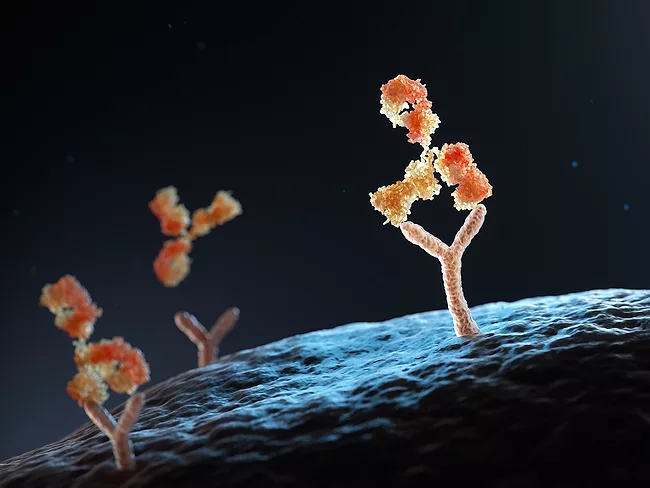
Lanova Medicines Ltd. has synthesized antibody-drug conjugates (ADCs) comprising antibodies targeting sialyl-Tn antigen (STn) linked to an exatecan derivative through a linker reported to be useful for the treatment of cancer.
Sino Biopharmaceutical Ltd. agreed to fully acquire Lanova Medicines Ltd. by buying an additional 95.09% stake in Lanova at a valuation of up to $950.92 million. Considering Lanova’s estimated cash and deposit of $450 million, Hong Kong-headquartered Sino agreed to pay $500.9 million to Lanova on the date of the transaction, set to close within 30 days of all conditions being satisfied, or July 31, 2025.
Sino Biopharmaceutical Ltd. agreed to fully acquire Lanova Medicines Ltd. by buying an additional 95.09% stake in Lanova at a valuation of up to $950.92 million. Considering Lanova’s estimated cash and deposit of $450 million, Hong Kong-headquartered Sino agreed to pay $500.9 million to Lanova on the date of the transaction, set to close within 30 days of all conditions being satisfied, or July 31, 2025.
Cadherin 17 (CDH17) is a membrane-bound cell adhesion molecule involved in tumor cell proliferation and is selectively overexpressed in several gastrointestinal malignancies, including colorectal cancer, gastric cancer and pancreatic cancer.
Merck & Co. Inc. has in-licensed Lanova Medicines Ltd.’s PD-1/VEGF bispecific antibody LM-299 in a deal worth up to $2.7 billion in a move to bolster its Keytruda (pembrolizumab) fortress. Under terms of the deal, Merck (known as MSD outside the U.S.) gains an exclusive global license to develop, manufacture and commercialize LM-299 in exchange for an up-front payment of $588 million. Shanghai-based Lanova is eligible to receive up to $2.7 billion in milestone payments associated with the technology transfer, development, regulatory approval and commercialization of LM-299 across multiple indications.
Merck & Co. Inc. has in-licensed Lanova Medicines Ltd.’s PD-1/VEGF bispecific antibody LM-299 in a deal worth up to $2.7 billion in a move to bolster its Keytruda (pembrolizumab) fortress. Under terms of the deal, Merck (known as MSD outside the U.S.) gains an exclusive global license to develop, manufacture and commercialize LM-299 in exchange for an up-front payment of $588 million. Shanghai-based Lanova is eligible to receive up to $2.7 billion in milestone payments associated with the technology transfer, development, regulatory approval and commercialization of LM-299 across multiple indications.
After raising $42 million in a series C1 round, Lanova Medicines Ltd. is advancing its lead phase III antibody-drug conjugate LM-302 that targets Claudin 18.2, as well as LM-299, an anti-PD-1/VEGF bispecific antibody, and LM-108, an anti-CCR8 monoclonal antibody. “Proceeds from this financing will allow us to expedite the development of our late-stage clinical programs, LM-302 and LM-108, moving us closer to market approval. We will also accelerate the clinical development of LM-299, which is currently in phase I clinical trials with best-in-class potential,” Lanova founder and CEO Crystal Qin said.
After raising $42 million in a series C1 round, Lanova Medicines Ltd. is advancing its lead phase III antibody-drug conjugate LM-302 that targets Claudin 18.2, as well as LM-299, an anti-PD-1/VEGF bispecific antibody, and LM-108, an anti-CCR8 monoclonal antibody. “Proceeds from this financing will allow us to expedite the development of our late-stage clinical programs, LM-302 and LM-108, moving us closer to market approval. We will also accelerate the clinical development of LM-299, which is currently in phase I clinical trials with best-in-class potential,” Lanova founder and CEO Crystal Qin said.
In a deal worth as much as $600 million, Lanova Medicines Ltd. licensed exclusive global rights to Astrazeneca plc for LM-305, an antibody-drug conjugate (ADC) targeting GPRC5D, for multiple myeloma (MM). Lanova will receive up-front and near-term payments of up to $55 million and development and commercial milestone payments of up to $545 million, as well as tiered royalties on net sales worldwide.
T-cell exhaustion is a differentiation state of T cells associated with tumor progression in the context of cancer. One of the co-stimulatory molecules in the tumor microenvironment, 4-1BB, triggers a signaling cascade resulting in cytokine secretion and upregulation of antiapoptotic molecules.