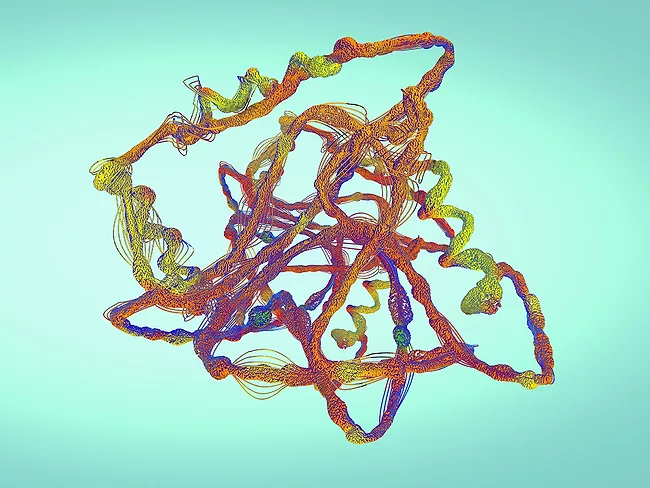
The Alphafold machine learning system for predicting a protein’s structure from its amino acid sequence has been adapted to make it possible to design de novo proteins that fold in a particular way and bind to prespecified target proteins. The sister system, called Alphadesign, works by generating random strings of amino acids, using Alphafold to predict their structure, and then iteratively optimizing the design.
The Alphafold machine learning system for predicting a protein’s structure from its amino acid sequence has been adapted to make it possible to design de novo proteins that fold in a particular way and bind to prespecified target proteins. The sister system, called Alphadesign, works by generating random strings of amino acids, using Alphafold to predict their structure, and then iteratively optimizing the design.
Scientists at the Center for Genomic Regulation (CRG) have developed an AI-based tool to design thousands of sequences that regulate DNA. They have also synthesized these molecules, called enhancers, to control gene activation in mouse hematopoietic stem cells, which they have tested in vitro.
Following Nobel Prize-winning chemist David Baker’s recipe for cooking an antidote to cobra venom using artificial intelligence (AI) could be faster and more effective than currently available methods. The ingredients and steps can be found in a new study published by the University of Washington scientist in collaboration with the Technical University of Denmark. They are ready for the next steps in preclinical trials.
Following Nobel Prize-winning chemist David Baker’s recipe for cooking an antidote to cobra venom using artificial intelligence (AI) could be faster and more effective than currently available methods. The ingredients and steps can be found in a new study published by the University of Washington (UW) scientist in collaboration with the Technical University of Denmark. They are ready for the next steps in preclinical trials.
David Baker, Demis Hassabis and John Jumper share the 2024 Nobel Prize in Chemistry for their contributions to the science of protein structure. David Baker was awarded half the prize “for computational protein design,” according to the Royal Swedish Academy of Sciences. Hassabis and Jumper shared the other half “for protein structure prediction.”
David Baker, director of the Institute for Protein Design at the University of Washington School of Medicine, is a pioneer in protein design. His contributions have been recognized with countless awards, and now, a place among the 2024 Clarivate Citation Laureates.
David Baker, Demis Hassabis and John Jumper share the 2024 Nobel Prize in Chemistry for their contributions to the science of protein structure. David Baker was awarded half the prize “for computational protein design,” according to the Royal Swedish Academy of Sciences. Hassabis and Jumper shared the other half “for protein structure prediction.”
David Baker, Demis Hassabis and John Jumper share the 2024 Nobel Prize in Chemistry for their contributions to the science of protein structure. David Baker was awarded half the prize “for computational protein design,” according to the Royal Swedish Academy of Sciences. Hassabis and Jumper shared the other half “for protein structure prediction.”
David Baker, director of the Institute for Protein Design at the University of Washington School of Medicine, is a pioneer in protein design. His contributions have been recognized with countless awards, and now, a place among the 2024 Clarivate Citation Laureates. Baker’s lab has developed several open-source software applications for nanotechnology and biomedicine. With these methods, scientists build new proteins that bind to drug targets and block them or activate cellular signals.