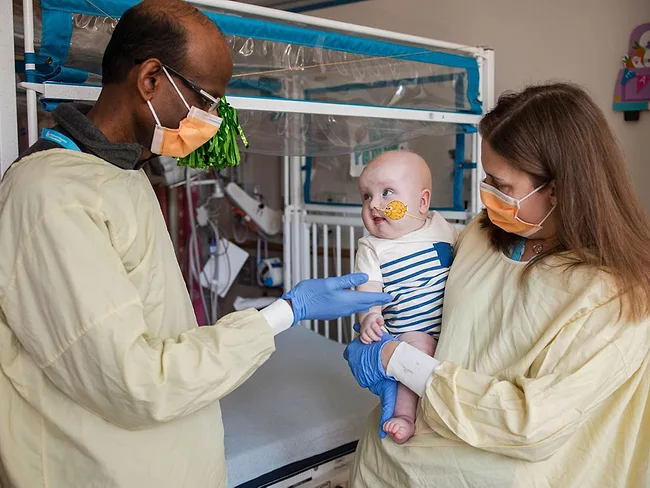
Gene editing technologies are moving forward in preclinical development with innovative strategies designed to treat diseases at their root and even reverse them.
Gene editing technologies are moving forward in preclinical development with innovative strategies designed to treat diseases at their root and even reverse them. However, many approaches still struggle to reach target cells or tissues – either they fail to arrive, or their efficacy is low. In vivo therapies face numerous challenges, but despite these hurdles, 2025 has marked a year of remarkable progress.
Gene editing technologies are moving forward in preclinical development with innovative strategies designed to treat diseases at their root and even reverse them. However, many approaches still struggle to reach target cells or tissues – either they fail to arrive, or their efficacy is low. In vivo therapies face numerous challenges, but despite these hurdles, 2025 has marked a year of remarkable progress.
A 24‑week pregnant woman fears for her unborn baby, who is developing with a sacrococcygeal teratoma so large and vascularized that it nearly surpasses the size of the fetus itself. Faced with this threat, surgeons operate inside the uterus in an open procedure that partially exposes the baby to remove the tumor and give the baby a chance to survive until birth. According to scientists presenting at the American Society of Gene & Cell Therapy's special meeting on Breakthroughs in Targeted In Vivo Gene Editing, this could be avoided.
The number of deaths caused by prion diseases reaches about 30,000 annually. Only 5 months pass from the diagnosis of seemingly healthy patients to the fatal outcome of this neurodegenerative condition, and just 1 month until quality of life is completely lost. Removing the brain protein that causes this genetic or infectious disorder could be achieved thanks to new gene-silencing techniques. At a special meeting of the American Society of Gene & Cell Therapy, in “AAV-mediated epigenetic editing for prion disease,” Sonia Vallabh presented not just the data of her research, but the impact of this disease on her family and on herself.
The field of gene therapy is experiencing major advances driven by precise editing technologies, such as base and prime editing, and by the design of increasingly sophisticated vectors to deliver payloads that could reverse the effects of diseases. However, in the transition to in vivo applications many approaches still fail in their attempt to effectively reach target tissues or cells.
A 24‑week pregnant woman fears for her unborn baby, who is developing with a sacrococcygeal teratoma so large and vascularized that it nearly surpasses the size of the fetus itself. Faced with this threat, surgeons operate inside the uterus in an open procedure that partially exposes the baby to remove the tumor and give the baby a chance to survive until birth. According to scientists presenting at the American Society of Gene & Cell Therapy's special meeting on Breakthroughs in Targeted In Vivo Gene Editing, this could be avoided.
The field of gene therapy is experiencing major advances driven by precise editing technologies, such as base and prime editing, and by the design of increasingly sophisticated vectors to deliver payloads that could reverse the effects of diseases. However, in the transition to in vivo applications many approaches still fail in their attempt to effectively reach target tissues or cells.
Inclusion body myositis (IBM) is the most common acquired myopathy in people over 50 years of age, characterized by chronic and progressive muscle weakness, where its pathogenesis involves inflammatory and degenerative pathways that are not well understood to date.
Bardet-Biedl syndrome (BBS) is a group of rare autosomal recessive ciliopathies characterized by dysfunction of primary cilia, which affects multiple organ systems and leads to early-onset obesity, progressive retinal degeneration resulting in vision loss or blindness, and renal abnormalities that may progress to renal failure. Mutations in the BBS10 gene are the second most prevalent cause of BBS, accounting for over 20% of cases.