
The high expectations that have been swirling around the nanomedicine field for almost a decade are still yet to be fully realized. However, there are promising signs that significant investments in early stage research over the past few years are starting to reap dividends with new generation therapeutic applications moving into clinical testing. The field is now expanding rapidly, and analysts and industry observers have identified it as a key enabling technology that is likely to impact the development of new therapeutics and diagnostics.
Venturing forth
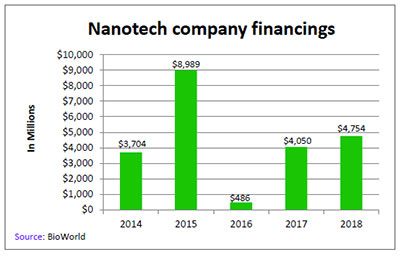 Both public and private companies working in the field have been attracting increasing levels of investments over the past five years. Collectively so far in 2018, companies have already raised approximately $4.8 billion, surpassing the $4 billion that was raised in 2017. (See Nanotech company financings, right.)
Private nanomedicine companies are beginning to attract the attention of venture capitalists. For example, in May, Pacific Palisades, Calif.-based Aadi Bioscience Inc. raised $23 million from a series A round, which will support clinical programs for ABI-009, its targeted nanoparticle albumin-bound mTOR inhibitor based on sirolimus or rapamycin, also known as nab-rapamycin.
The company is currently enrolling its registration trial for advanced perivascular epithelioid cell tumors, an extremely rare form of sarcoma. The phase II study will enroll approximately 30 to 35 patients and the primary endpoint for the study is the overall response rate.
The firm is led by Abraxane (nab-paclitaxel) co-inventor Neil Desai, and the firm in-licensed ABI-009 from Celgene Corp. in 2014. (See BioWorld Today, May 21, 2014.)
Last July, Cleveland-based Diasome Pharmaceuticals Inc. reported new funding of up to $30 million led by Medicxi, a European life sciences venture capital firm. Its hepatic-directed vesicle that carries insulin and a specific hepatocyte-targeting molecule is additive to commercial insulin therapies.
The company is using the funding for its clinical development program and general operations, including the execution of its ongoing ISLE-1 (InSulin Liver Effect) phase IIb study of HDV-Insulin in subjects with type 1 diabetes.
Also last year, Tarveda Therapeutics Inc. generated $30 million in a series D financing, which will support development of its Pentarin miniaturized drug conjugates. In early stage clinical testing is PEN-221, a miniaturized conjugate targeting somatostatin receptor 2 (SSTR2), which is expressed in neuroendocrine and small-cell lung cancers, and PEN-866, a miniaturized HSP90-targeting drug conjugate for use in advanced, topoisomerase 1-sensitive cancer patients.
At the American Society for Clinical Oncology meeting in June, it reported phase I results from the ongoing phase I/IIa study of PEN-221. It was designed as a dose-escalating study to assess safety, tolerability, pharmacokinetics and preliminary antitumor activity of the compound in patients with SSTR2-expressing advanced neuroendocrine or small-cell lung cancers. The results show that PEN-221 appears to be well-tolerated with evidence of antitumor activity seen in multiple patients.
In conjunction with the closing of a $10 million series A financing, Ann Arbor, Mich.-based Nanobio Corp. said it changed its corporate name to Bluewillow Biologics, which reflects, the company explained, its evolution to a vaccines-focused company, and commitment to advancing its intranasal technology to develop new vaccines for several respiratory and sexually transmitted diseases. Its original focus was on topical nanoscale therapies for various dermatology applications. The intranasal vaccine platform is built upon the Nanovax technology that employs an oil-in-water nanoemulsion adjuvant to elicit both systemic and mucosal immunity when applied intranasally.
The company is developing intranasal vaccines for several respiratory and sexually transmitted infections, including respiratory syncytial virus (RSV), pertussis, influenza, anthrax, prophylactic and therapeutic HSV-2 and chlamydia.
Clinical developments
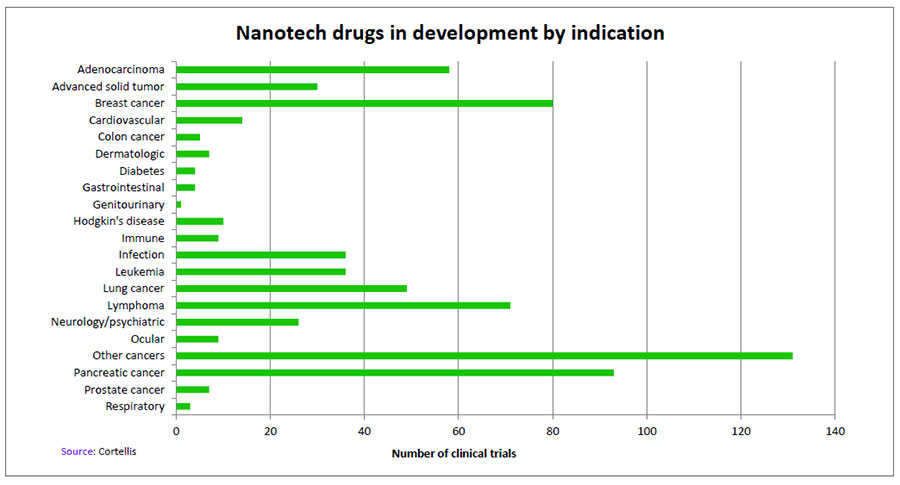
Not surprisingly, the major indication served by innovative new therapies being shaped by nanotechnology is oncology, although other indications are being targeted such as diabetes and respiratory diseases. (See Nanotech drugs in development by indication, below.)
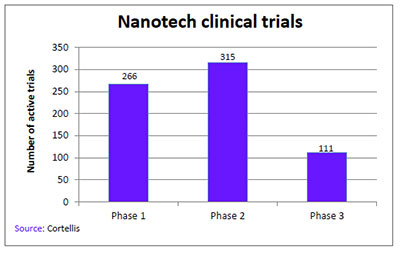 While many of those nanomedicines under development are still in the early phases, a number of compounds have been advanced into mid- or late-stage clinical trials. (See Nanotech clinical trials, right.)
Novavax Inc., for example, reported it recently reached a significant enrollment milestone in the Prepare phase III trial of its respiratory syncytial virus F protein recombinant nanoparticle vaccine (RSV F vaccine) for infants via maternal immunization, achieving approximately 4,600 participants, of whom, at least 3,000 have received the vaccine.
The primary objective of the study is to determine the efficacy of maternal immunization with the RSV F vaccine against medically significant RSV-positive lower respiratory tract infection in infants through a minimum of the first 90 days of life and up through the first six months of life. The company expects to report on the interim data in the first quarter of next year.
Genprex Inc., of Austin, Texas, said it selected Accenture to provide clinical data management services to help accelerate the clinical development of its lead drug candidate, Oncoprex (TUSC2 nanoparticles), for the treatment of non-small-cell lung cancer (NSCLC).
Oncoprex is a TUSC2 gene encapsulated in a positively charged nanovesicle made from lipid molecules and injected intravenously, which can specifically target cancer cells and insert wild-type TUSC2 into cellular DNA, effectively increasing expression of the TUSC2 protein and promoting tumor cell death.
Last week, the company reported it had amended its agreement with The University of Texas MD Anderson Cancer Center to resume patient enrollment in its phase I/II trial evaluating the combination of Oncoprex and Tarceva (erlotinib) for the treatment of stage IV NSCLC.
Previously reported interim data from nine patients from the phase II portion of the trial showed a disease control rate of 78 percent, with seven out of nine patients achieving stable disease or better, including one complete response.