
BB&T Contributing Editor
MIAMI BEACH — The 8th annual meeting of Global Symposium on Motion Preservation Technology, sponsored by the Spinal Arthroplasty Society (Aurora, Illinois), drew more than 1,750 attendees, of whom about half came from outside the U.S. The audience of neurosurgeons and spinal surgeons was treated to a wide selection of workshops and presentations by companies seeking to promote their surgical techniques and devices for use as alternatives to spinal fusion. The fusion of vertebrae tends to reduce flexibility and range of motion and typically involves a lengthy recovery and rehabilitation, thus driving a search for alternatives.
The degenerative cascade in the posterior elements typically leads surgeons to perform a wide decompression, i.e., removal of the lamina and medial facet joints that press on nerve roots. Fusion hardware is implanted to stabilize the spine. Artificial discs and dynamic stabilization devices offer an alternative to fusion for fixing aching backs.
An estimated 30 million people in the U.S. suffer from back pain, as intervertebral disc degeneration is a natural progression of the aging process. Physical therapy and medication provide a solution in many cases. However, about 15% of this population, or 4.5 million people, still experience back pain despite such conservative therapy. The next level of treatment is spinal surgery, either disc replacement or spinal fusion.
During a panel discussion on "The Future of Spine Surgery," Larry Khoo, MD, of the UCLA Spine Center (Santa Monica, California), noted that minimally invasive percutaneous spinal procedures have three to four times fewer complications than spinal fusion procedures which he attributed in part to the shorter hospital stay. He said that spinal fusion procedures have an 18% complication rate. Interspinous non-fusion devices for dynamic stabilization were characterized as aiding in the natural healing process and include the following devices: Wallis from Abbott Spine (Austin Texas), a subsidiary of Abbott Laboratories (Abbott Park, Illinois); Dynesys from Zimmer Spine (Edina, Minnesota), a subsidiary of Zimmer (Warsaw, Indiana); and X-Stop from Med-tronic Spinal and Biologics (Memphis), a subsidiary of Medtronic (Minneapolis).
Total disc replacement, MIS procedures
A dominant theme at SAS8, as the conference is known, involved numerous clinical updates on cervical and lumbar total disc replacement (TDR) arthroplasty. TDR shared the spotlight with the growing field of less invasive technologies such as pedicle screw-based dynamic stabilization devices, interspinous spacers, facet replacement and nucleus replacement. There presently are two FDA-cleared lumbar disc replacement devices marketed in the U.S., Charité from DePuy Spine (Raynham, Massachusetts), a subsidiary of Johnson & Johnson (New Brunswick, New Jersey), and ProDisc-L from Synthes Spine (West Chester, Pennsylvania), a subsidiary of Synthes (Solothurn, Switzerland).
Many companies currently market cervical TDR devices in Europe and are in clinical trials in pursuit of the U.S. market. The cervical disc products currently sold in the U.S. are the Prestige cervical disc system from Medtronic Spinal and Biologics (Memphis), and the ProDisc-C from Synthes Spine. Medtronic is still awaiting approval of its Bryan cervical disc system, a titanium implant with an elastomeric core. Motion preservation in the cervical region is more critical than in the lumbar spine and the more accessible exposure of the cervical spine makes the surgical procedure less challenging.
Consolidation sprouts anew
There is a proliferation of small and emerging spinal device companies that are developing products for use in motion preservation. While there is expected to be some fallout from failed clinical trials, challenges to intellectual property are also likely to arise as these companies enter the market. All the leading orthopedic companies had entered the spinal products market via an initial round of acquisitions of private spinal products companies some years back
A subsequent round of acquisitions has begun, as evidenced by the following transactions during the past year: Synthes acquired N Spine (San Diego), a developer and marketer of devices to treat lumbar spinal disorders using posterior dynamic stabilization. Exactech (Gainesville, Florida) acquired Altiva (Charlotte, North Carolina), marketer of a broad line of implants and instruments used in spinal surgery. Medtronic acquired Kyphon (Sunnyvale, California), a highly regarded company that markets balloon kyphoplasty devices for the treatment of spinal fractures caused by osteoporosis or cancer. Kyphon had previously acquired St. Francis Medical Technologies (Alameda, California), maker of the X-Stop interspinous process decompression system, the first FDA-approved interspinous process device for treating lumbar spinal stenosis, and Disc-O-Tech Medical Technologies (Herzeliya, Israel), marketer of expandable implants for minimally invasive orthopedic procedures.
Stryker Spine (Allendale, New Jersey), a subsidiary of Stryker (Kalamazoo, Michigan), markets a line of PEEK-based vertebral body replacement implants and has developed minimally invasive spinal surgery systems that have recently been introduced to spine surgeons around the world. Its newly introduced Mantis percutaneous system allows surgeons to treat multiple level pathologies in a less invasive, percutaneous fashion while allowing for pre-contouring of rods for easier insertion.
Stryker's FlexiCore metal-on-metal lumbar TDR has a fixed stationary center of rotation and is implanted as a single unit from a straight anterior or anteriolateral direction. It is sold in Europe and South Africa and is in an FDA-approved clinical trial.
CerviCore, a cervical TDR, also is an investigational device in clinical trials in the U.S. It does not yet have the CE mark. It is a cobalt-chrome device and its articulating surface has a saddle shape. It is distinguished from other companies' spinal devices that went from lumbar to cervical TDRs by making the device smaller but without changing the biomechanics of the articulating surface.
Globus Medical (Audubon, Pennsylvania) markets a range of devices for spinal fusion, including the Pivot percutaneous posterior stabilization system, Providence and Assure anterior cervical plating systems and NuBone, a demineralized osteoconductive bone graft. It soon will introduce MicroFuse, a resorbable PGA/PLA bone void filler for orthopedic applications that has an interconnected porosity structure for bony ingrowth. It will be available in sheets, granules and in molded shapes.
Globus Medical has just launched in the U.S. the Beacon stabilization system, a spinal pedicle fixation device for treating degenerative disc disease. A connector allows for medial lateral offset and its low-profile screw allows for good bone graft placement and single step locking. The company's workshop featured the Transition dynamic stabilization system that is designed to match the natural biomechanics of the lumbar spine and addresses the interpedicular distance changes, the Flexus unitary implant with a simple minimally invasive unilateral approach for opening the neural foramen, and the Secure anterior cervical TDR, a semi-constrained device that is implanted by a simple insertion technique and is in an FDA-approved IDE clinical trial.
LDR (Austin, Texas/Troyes, France) has launched ROI-A, an anterior approach implant that uses the company's VerteBridge anchoring technology. It is fabricated from PEEK-Optima material for biocompatibility and radiolucency and features a zero-profile design with no hardware protruding anterior of the vertebral bodies. Its screwless, self-locking anchoring plates are designed for initial and long-term stability. It will be incorporated into LDR's new stand-alone partial vertebral body replacement devices. The surgical technique employs a minimally invasive direct anterior approach which allows insertion of the curved anchoring plates along the sagittal plane, thus requiring no additional exposure of the vertebral bodies.
Amedica (Salt Lake City) markets the Valeo C compact VBR spacer and Valeo TL lumbar spacer. These products are fabricated from medical-grade silicon nitride. Silicon nitride is used in industrial applications such as in jet engines and wheel bearings in race cars. The company claims that silicon nitride is 20 times stronger than PEEK and has excellent imaging compatibility. The Valeo VBR spacer is resigned to restore the biomechanical integrity of the anterior, middle, and posterior spine. The Valeo TL lumbar spacer has a dense outer ring to replicate the loading function of cortical bone and sharp knurls to bite into bone and reduce implant migration.
Scient'x (Maitland, Florida), majority owned by Healthpoint Capital (New York), recently received 510(k) clearance for its Isobar Duo dynamic stabilization system. The device is an extension of its original Isobar dynamic TTL-rod and allows a surgeon to have controlled motion at two levels. The Isobar Duo provides immobilization and stabilization of spinal segments in skeletally mature patients as an adjunct to fusion in the treatment of acute and chronic instabilities or deformities of the thoracic, lumbar and sacral spine. Scient'x had licensed the Isobar dynamic rod from Alphatec Spine (Carlsbad, California).
Disc Motion Technologies (Boca Raton, Florida) was founded by two spine surgeons in England in 2003 and relocated to the U.S. in 2005. It held a workshop to review its total lumbar joint replacement system. The system's components are True TSMS, TrueDyne PDS and TrueDyne dynamic pedicle screw. Disc Motion is the first company to market a total joint replacement system, which it has just started selling in Europe.
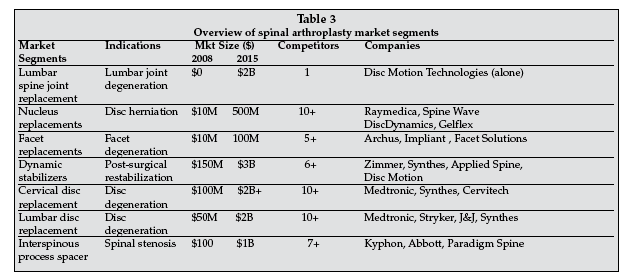
The TSMS features a paired set of lumbar discs that are implanted via a bilateral, posterior lateral surgical approach. They are implanted with posterior dynamic stabilizers which have a matching center of rotation that replaces the facets. The TrueDyne PDS can also be used alone for spine joint restabilization, replacing a fusion. The TrueDyne dynamic pedicle screw also can potentially be used with titanium rods for treating adult scoliosis. (See Table 3 on page 11 for an overview of the spinal arthroplasty market segments.)
SeaSpine (Vista, California) markets products for cervical and thoracolumbar fusions and is developing cervical and lumbar TDR devices. Its Zuma system is a combined thoracolumbar and vertebral body replacement device that has an articulating plate for a precise fit. Its one-piece design incorporates an anterior fixation plate and a radiolucent vertebral body spacer. The product includes four screws that are locked in one step and a locking plate for improved stability. The Zuma system has the CE mark and will soon be marketed in Europe.
Spine Wave (Shelton, Connecticut) has three products that are in early stages of commercialization in the U.S. They include the StaXX FX structural kyphoplasty for vertebral compression fracture reduction, StaXX XD expandable device for vertebral body replacement, and the CapSure pedicle screw used along with the StaXX XD system. The company is in the process of building a direct sales force. NuCore is an injectable nucleus replacement product that is in pilot trials in the U.S. It is a crosslinked, protein-based material.
X-Spine (Miamisburg, Ohio) is developing the Flexcet dynamic rod system. It is comprised of titanium and has a polycarbonate urethane core that is flexible and allows for motion. The product will initially be marketed as an adjunct for fusion after receiving 510(k) approval. Clinical trials are planned for late 2009. The company also is developing the X-Dyne cervical disc. X-Spine markets a line of devices used in thoracic, lumbar and cervical fusion procedures, including the Capless LI and Capless XL pedicle screw systems, the Spider cervical plating system, and Butrex anterior lumbar buttress plating system.
TranS1 (Wilmington, North Carolina) sells AxiaLIF in the U.S. and Europe. Combined with facet screws, it provides a percutaneous 360 degree fusion at L5-S1. The company received 510(k) clearance from the FDA in April 2008 for AxiaLIF 2L, a two-level percutaneous lumbar fusion system. A percutaneous access and fusion system enables lumbar fusion to be performed with complete preservation of the annulus and all paraspinal soft tissue structures. The system is designed to treat degenerative disc disease at both the L5-S1 and L4-L5 lumbar discs through a single, 1-1/2" incision.
The company is conducting clinical trials in Europe on an in situ curing silicone for use in nucleus replacement that spares all soft tissue components and is delivered through a percutaneous trans-sacral approach. Approval is expected in 2012-2013. TranS1 completed an initial public offering in late 2007.
Other publicly traded companies that specialize in spinal products are Alphatec Spine and NuVasive (San Diego).
Interventional Spine (Irvine, California) markets the PercuDyn system. It is promoted as the first and only percutaneous bilateral facet augmentation system for treating lumbar spine stenosis at L5-S1. The advantages of this one-size-fits-all device are: less hardware implanted in the patient, less post-op pain and less operating room time. The company's Perpos PLS system is a percutaneous transfacet-pedicular compression device for posterior stabilization during a fusion procedure of the lower spine.
Innovative Spine Technologies (Mansfield, Mass- achusetts) markets the Paramount pedicle screw system for use in single and multi-level minimally invasive lumbar fusion procedures. The company sponsored a workshop that featured its Axient pedicle screw-based dynamic fixation system, which provides segmental stability with controlled physiological motion.
Arthrocare Spine (Austin, Texas) featured its new MD SpineWand, a device for the controlled removal of disc material by a minimally invasive approach and for spinal disc decompression using its patented Coblation technology. It entails the use of bipolar electromagnetic energy to excite electrolytes in saline solution, creating a precisely focused plasma. The energized particles in the plasma field ablate tissue by molecular dissociation at low temperatures, thereby preserving the integrity of surrounding healthy tissue.
Facet replacement products
Archus Orthopedics (Redmond, Washington) is developing a family of reconstructive implants to treat a variety of spine disorders resulting from degenerative changes in the facet joints. It has the CE mark on four facet replacement products which facilitate treatment of lumbar stenosis and are used with, or after, implantation of various interbody motion preservation devices such as artificial discs and nucleus replacements.
Its TFAS (total facet arthroplasty system) articulating joint prostheses are intended to restore normal motion and provide stabilization of spinal segments in skeletally mature patients. It can be used as an adjunct to laminectomy, laminotomy, neural decompression and facetectomy, in lieu of fusion, for treatment of instabilities or deformities of the lumbar spine. It is in clinical trials at 21 sites in the U.S., to be increased to 35 sites.
Facet Solutions (Logan, Utah) plans to begin pivotal clinical trials in the U.S. and Europe later this year for its AFRS (anatomic facet replacement system) implant, a joint reconstruction device that matches the size and shape of the facet joint. It is designed to provide patients with pain relief and normal motion. A pilot study on 20 patients in the U.S. and 10 outside the country have been completed.
Impliant (Ramat Poleg, Israel) is developing the TOPS system, a mobile posterior arthroplasty device that is designed to alleviate persistent leg and low back pain stemming from severe spinal stenosis, a back condition that may also be accompanied by degenerative spondylolisthesis and facet arthrosis. The company has redesigned the product after patient failures in a clinical trial.
Anular repair products
Anulex Technologies (Minnetonka, Minnesota) markets two products for post-discectomy anular repair, the Inclose surgical mesh system and Xclose tissue repair system. The products received 510(k) approvals and are made from polyethylene terephthalate (PET).
Intrinsic Therapeutics (Woburn, Massachusetts) has pioneered the anular reconstruction procedure that is based on feedback from orthopedic and neurosurgeons and is used to repair the annulus fibrosus following a lumbar disc herniation. The company markets in Europe its Barricaid anular reconstruction device for sealing anular defects during discectomies. It also has a CE mark for Barricaid ARD for more severe anular pathologies. The company is in discussion with the FDA for approval to conduct an IDE clinical trial.