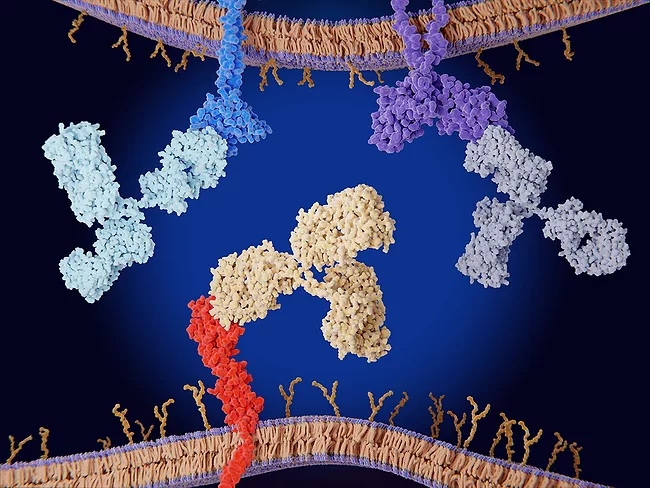
A novel bispecific immunotherapy developed by Roche AG to target pancreatic cancer showed promising results combined with radiation therapy in preclinical trials carried out at the University of Colorado.
Shanghai Junshi Biosciences Co. Ltd.’s anti-PD-1 monoclonal antibody toripalimab showed positive interim event-free survival (EFS) results in a phase III study to treat patients with resectable non-small-cell lung cancer (NSCLC). This is the world’s first phase III trial that shows perioperative treatment with an anti-PD-1 monoclonal antibody significantly extends EFS of patients with resectable NSCLC, according to Shanghai-based Junshi Biosciences.
Shanghai Junshi Biosciences Co. Ltd.’s anti-PD-1 monoclonal antibody toripalimab showed positive interim event-free survival (EFS) results in a phase III study to treat patients with resectable non-small-cell lung cancer (NSCLC). This is the world’s first phase III trial that shows perioperative treatment with an anti-PD-1 monoclonal antibody significantly extends EFS of patients with resectable NSCLC, according to Shanghai-based Junshi Biosciences.
Researchers from Bright Peak Therapeutics AG presented the discovery and preclinical characterization of a novel first-in-class PD-1/interleukin-18 (IL-18) immunocytokine, BPT-567.
Biocytogen Pharmaceuticals Co. Ltd.’s wholly owned subsidiary, Eucure Biopharma Co. Ltd., licensed exclusive greater China rights to YH-008 to Chipscreen Biosciences Co. Ltd. in a ¥596 million (US$86 million) deal. Chipscreen subsidiary, Chipscreen Newway Biosciences Co. Ltd., will develop and commercialize the bispecific antibody in mainland China, Hong Kong, Macau and Taiwan.
Ocean Biomedical Inc. has discovered bispecific antibodies that target Chitinase 3-like-1 (CHI3L1) and immune checkpoint inhibitors, killing glioblastoma cells and melanoma cells, and blocking the metastasis of malignant melanoma cells to the lung by over 90%.
In a massive deal that is one of the year’s biggest, Akeso Inc. signed a collaboration and license deal with Summit Therapeutics Inc. to out-license its bispecific antibody, ivonescimab (AK-112), for development and commercialization in the U.S., Canada, Europe and Japan.
Treatment with anti-PD-1 checkpoint inhibitors is not effective in all cases, and around 10% of melanoma patients actually experience a rapid deterioration, a phenomenon known as hyperprogressive disease. Some studies have linked hyperprogression to specific immune cell populations or genes, and it remains unclear if this complication can be directly attributed to checkpoint immunotherapy or not.