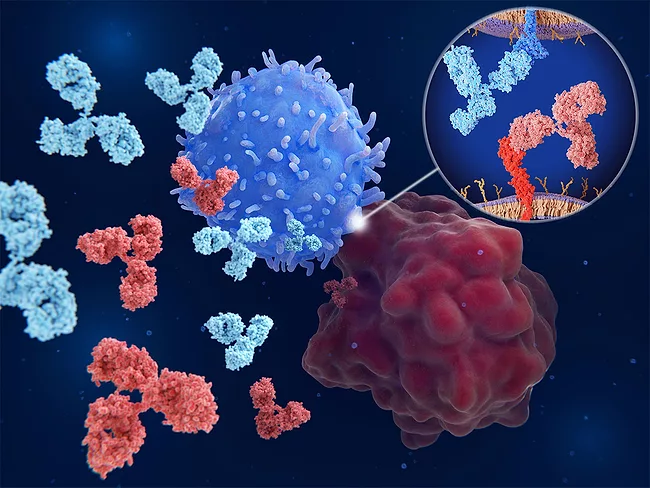
Instil Bio Inc. and Immuneonco Biopharmaceuticals Inc. laid out their global registrational strategy for the PD-L1xVEGF bispecific antibody SYN-2510 (IMM-2510) in front-line non-small-cell lung cancer and front-line triple-negative breast cancer amid a wild stock ride for the former over the past week and a half.
More than three months ago, investors first learned that ivonescimab, a PD-1/VEGF-targeting bispecific antibody from Summit Therapeutics and Akeso Pharmaceuticals Inc., bested Keytruda (pembrolizumab) in PD-L1-positive non-small-cell lung cancer (NSCLC). At the 2024 World Conference on Lung Cancer over the weekend, Summit rolled out detailed data from the phase III Harmoni-2 trial, which included a nearly doubling of progression-free survival for ivonescimab compared to Merck & Co. Inc.’s established blockbuster drug.
More than three months ago, investors first learned that ivonescimab, a PD-1/VEGF-targeting bispecific antibody from Summit Therapeutics and Akeso Pharmaceuticals Inc., bested Keytruda (pembrolizumab) in PD-L1-positive non-small-cell lung cancer (NSCLC). At the 2024 World Conference on Lung Cancer over the weekend, Summit rolled out detailed data from the phase III Harmoni-2 trial, which included a nearly doubling of progression-free survival for ivonescimab compared to Merck & Co. Inc.’s established blockbuster drug.
On the heels of an AU$100 million (US$66.5 million) capital raise, Immutep Ltd. announced positive top-line results in first-line head and neck cancer with its lead candidate, eftilagimod, in combination with Merck & Co. Inc.’s Keytruda (pembrolizumab).
On the heels of an AU$100 million (US$66.5 million) capital raise, Immutep Ltd. announced positive top-line results in first-line head and neck cancer with its lead candidate, eftilagimod, in combination with Merck & Co. Inc.’s Keytruda (pembrolizumab).
The adverse effects of PD-1 blockers on the CNS observed in cancer patients could occur through their effects on an enzyme that activates microglia. Pharmacological inhibition of the enzyme in mice reduced microglial activation and cognitive deficit without altering the antitumor capacity of the immunotherapy.
High weight is associated with a greater risk of developing many cancers, and with an increased risk of metastasis. But in some cancers such as renal cell carcinoma, it is also associated with better survival and a better response to immunotherapies in particular.
The adverse effects of PD-1 blockers on the CNS observed in cancer patients could occur through their effects on an enzyme that activates microglia. Pharmacological inhibition of the enzyme in mice reduced microglial activation and cognitive deficit without altering the antitumor capacity of the immunotherapy.
High weight is associated with a greater risk of developing many cancers, and with an increased risk of metastasis. But in some cancers such as renal cell carcinoma, it is also associated with better survival and a better response to immunotherapies in particular.
High weight is associated with a greater risk of developing many cancers, and with an increased risk of metastasis. But in some cancers such as renal cell carcinoma, it is also associated with better survival and a better response to immunotherapies in particular.