Therini Bio Inc. has closed a US$36 million series A financing round that will support its work on developing fibrin-targeted therapies for diseases driven by chronic inflammation, including Alzheimer’s disease, multiple sclerosis and retinal diseases such as diabetic macular edema.
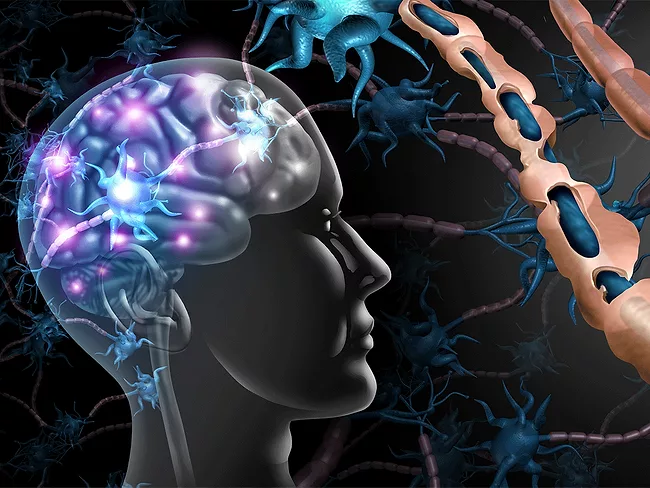
The loss of myelin in the cerebral cortex of multiple sclerosis (MS) patients could be recovered if oligodendrocytes, the cells that myelinate neuronal axons, work at a higher rate than they are destroyed. However, a group of scientists from the University of Munich have shown, in cortical MS mice, that this does not occur. The oligodendrocytes do not contribute to remyelination efficiently.
Pipeline Therapeutics Inc., which received U.S. FDA approval to move into a phase Ib/IIa study of PIPE-307 in relapsing-remitting multiple sclerosis (RRMS) last year, will be advancing the oral, small-molecule muscarinic M1 receptor antagonist in collaboration with Janssen Pharmaceutica NV in an agreement that could be worth more than $1 billion.
Aural Analytics Inc. received a breakthrough device designation from the U.S. FDA for its Speech Vitals-ALS technology, a software application that collects and analyzes speech recordings to help monitor amyotrophic lateral sclerosis (ALS) in adults in clinic and home settings. The software could improve management of the devastating disease.
Research at Bristol Myers Squibb Co. has led to the development of [11]-carbon-labeled compounds targeting Bruton tyrosine kinase (BTK) as positron emission tomography (PET) imaging agents for the diagnosis of multiple sclerosis.
Phase II data that rolled out from Merck KGaA with its Bruton's tyrosine kinase (BTK) inhibitor evobrutinib in relapsed multiple sclerosis (MS) put more eyeballs on the mechanism. It’s already well validated in oncology, but resistance has arisen there, and at least two firms – Beigene Ltd. and Nurix Therapeutics Inc. – are striving for solutions with degrader candidates.
Biohaven Ltd. has acquired global rights, excluding China regions, from Hangzhou Highlightll Pharmaceutical Co. Ltd. for TLL-041, now designated BHV-8000, an oral, brain-penetrant, highly selective, dual TYK2/JAK1 inhibitor, for neurological disorders.
FDA approval of Aduhelm (aducanumab), as the first disease modifying drug for Alzheimer’s, may have had a distinctly lukewarm reception in some quarters, but it is an important starting point in treating dementia, with a myriad of other avenues now being pursued in discovery and development.
Tumor necrosis factor (TNF) has been implicated in the pathogenesis of several neurological disorders, such as multiple sclerosis (MS). Its transmembrane form activates the type II tumor necrosis factor receptor (TNFR2), functioning via cell-to-cell contact. In contrast, its soluble form activates TNFR1; studies in animal models have evidenced TNFR1 to activate neurotoxic pathways, while TNFR2 activation pathways may have protective effects within the central nervous system due to activation of reparative mechanisms.