Samsung Life Science Fund, created jointly by Samsung Biologics Co. Ltd., Samsung Biopeis Co. Ltd. and Samsung C&T Corp., said it invested in Waltham, Mass.-based antibody-drug conjugate (ADC) developer Brickbio Inc. on March 18, as its fifth biotech investment.
At first glance, the number of drugs that received accelerated approval from the U.S. FDA’s Center for Drug Evaluation and Research (CDER) in 2023 was nothing to write home about. Yes, CDER granted nine accelerated approvals last year, up from six in 2022. But the proportion of novel drugs with accelerated approval was 16% both years. And when compared with the 12 drugs in 2020 and the 14 that received accelerated approval in 2021, last year’s crop was a little lackluster. However, a deeper look at the 2023 class of accelerated approvals shows a historic milestone. For the first time since the path was created in 1992, the number of novel biologics getting accelerated approval at CDER outpaced the number of small-molecule drugs.
South Korean biopharmaceutical company Celltrion Inc. submitted a BLA to the U.S. FDA on March 10 to gain approval for its Xolair (omalizumab; Novartis AG) biosimilar, CT-P39, across major indications of asthma, food allergy and chronic spontaneous urticaria.
South Korean biopharmaceutical company Celltrion Inc. submitted a BLA to the U.S. FDA on March 10 to gain approval for its Xolair (omalizumab; Novartis AG) biosimilar, CT-P39, across major indications of asthma, food allergy and chronic spontaneous urticaria.
China’s National Medical Products Administration (NMPA) cleared 40 novel innovative drugs in 2023, of which nearly half were cancer therapies, marking a significant increase from the 21 new class 1 drugs approved in 2022.
China’s National Medical Products Administration (NMPA) cleared 40 novel innovative drugs in 2023, of which nearly half were cancer therapies, marking a significant increase from the 21 new class 1 drugs approved in 2022.
Weaving in a loose regulatory end from March 2020 when it deemed nearly 100 NDAs as BLAs, the U.S. FDA released a final rule codifying its current approach to the use of drug master files for those products and their potential biosimilar competition.
As South Korea increases its stakes on the “bioeconomy” as its next growth engine and as its “second semiconductor industry,” leading domestic biologic and biosimilar drug producers such as Samsung Biologics Co. Ltd. and Celltrion Inc. are setting record production targets to become forerunners in the global playing field.
As South Korea increases its stakes on the “bioeconomy” as its next growth engine and as its “second semiconductor industry,” leading domestic biologic and biosimilar drug producers such as Samsung Biologics Co. Ltd. and Celltrion Inc. are setting record production targets to become forerunners in the global playing field.
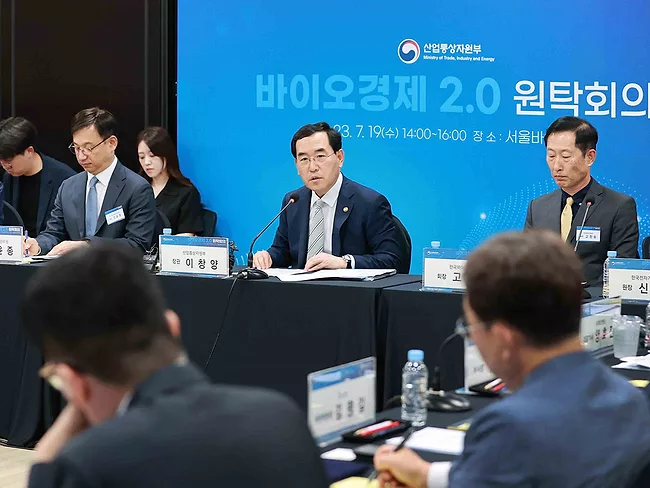
In July 2023, South Korea’s Ministry of Trade, Industry and Energy ramped up efforts to kickstart the so-called “Bio Economy 2.0,” the newfound initiative that banks on the biopharmaceutical industry to potentially revitalize the country’s slowing economic and social growth. Highlighting four major areas – biopharmaceuticals, biomaterials, bioenergy and digital technologies – as the four “wheels” to carry the biopharma industry, the new plan underscored the government’s unwavering support for the sector while highlighting its vision to become the “number one bioeconomy” worldwide.