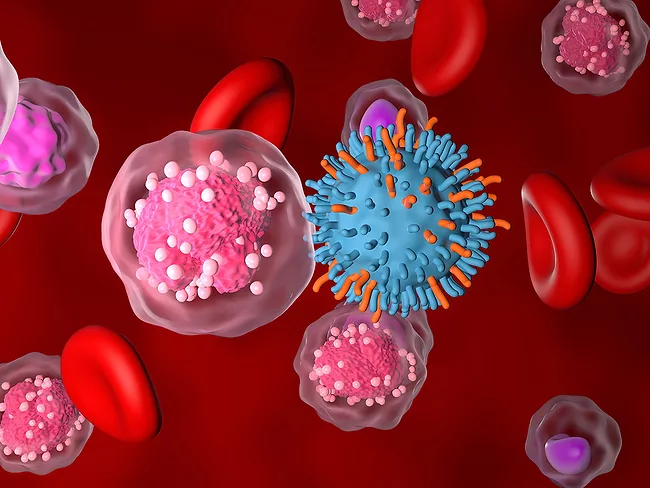
Transition Bio Ltd. has disclosed YTH domain-containing protein 1 (YTHDC1; YT521-B) inhibitors reported to be useful for the treatment of acute myeloid leukemia (AML).
Despite the variety of treatments available for acute myeloid leukemia (AML), their therapeutic efficacy remains limited, and the 5-year survival rate is still below 30%. Epigenetic changes, including DNA methylation and histone modification, appear to play a role in AML development and progression, emerging as promising targets.
A study has demonstrated the potential of a novel ligand-based CAR T-cell therapy for targeting CD7-positive T-cell malignancies, including T-cell acute lymphoblastic leukemia (T-ALL) and T-cell lymphomas. The receptor CD7 is a prominent target antigen, being expressed in around 95% of T-ALL, 50% of peripheral T-cell lymphomas and 10% of acute myeloid leukemias.
Pleco Therapeutics BV has held a successful pre-IND meeting with the FDA to discuss the continued development of PTX-252, an intravenous formulation designed to treat patients with acute myeloid leukemia (AML).
In a recently published study, researchers from Cima Universidad de Navarra and collaborators presented a novel SdAb-based CAR T-cell discovery platform that allows the generation, characterization and selection of SdAbs by several properties.
Leukemic stem cells (LSCs) and stemness signatures contribute to minimal residual disease in patients with acute myeloid leukemia (AML), which is associated with an increased risk of relapse. The presence of LSCs predicts treatment success and, therefore, eliminating LSCs has been proposed as a promising strategy to avoid relapses.
Auron Therapeutics Inc. has received FDA clearance of its IND application for its oral KAT2A/B degrader AUTX-703 in hematological malignancies. A phase I proof-of-concept trial in acute myeloid leukemia (AML) will open enrollment this quarter, supported by a recently completed $27 million series B financing.
Kymera Therapeutics Inc. has published the characterization of KT-253, a novel compound designed to degrade the murine double minute 2 (MDM2) protein, offering a promising approach for cancers retaining wild-type p53.
Hemogenyx Pharmaceuticals plc has obtained approval by the institutional review board (IRB) of the company’s first clinical site to initiate a phase I trial of the company’s lead asset, HEMO-CAR-T, for the treatment of relapsed or refractory acute myeloid leukemia (AML) in adults.