Areteia Therapeutics Inc. has launched to put its lead candidate, dexpramipexole, an oral treatment for eosinophilic asthma, through a phase III trial. Areteia was created by Knopp Biosciences LLC, which has put the small-molecule eosinophil maturation inhibitor through a phase II study, and also by Population Health Partners. Areteia has both the development and commercial rights to dexpramipexole.
Wall Street cheered a potential, long hoped-for breakthrough in idiopathic pulmonary fibrosis (IPF), and shares of Pliant Therapeutics Inc. (NASDAQ:PLRX) closed at $23, up $14.12, or 159%, after investors learned of positive phase IIa data with PLN-74809. The trial met its primary and secondary endpoints, proving PLN-74809, a dual integrin alpha-V/beta-1/6 antagonist, well-tolerated with a favorable pharmacokinetic (PK) profile. Exploratory efficacy endpoints measured changes in forced vital capacity (FVC) and quantitative lung fibrosis (QLF) imaging, and the drug turned up a dose-dependent treatment effect on FVC and QLF vs. placebo over 12 weeks of treatment. Serum biomarkers were examined, too.
As an ever-increasing share of companies seek signs of efficacy for investigational drugs in early stage studies, single-arm trials to confirm those effects and support marketing applications are also becoming more common. Now, China’s Center for Drug Evaluation has released draft guidelines on how single-arm trials can be regulated, used to support the new drug application for cancer drugs, and accelerate oncology drug development.
As an ever-increasing share of companies seek signs of efficacy for investigational drugs in early stage studies, single-arm trials to confirm those effects and support marketing applications are also becoming more common. Now, China’s Center for Drug Evaluation has released draft guidelines on how single-arm trials can be regulated, used to support the new drug application for cancer drugs, and accelerate oncology drug development.
After three years of clinical research, Royal Philips NV said its Tack (4-F) endovascular system has shown promising results for arterial dissection repair following balloon angioplasty in patients with critical limb ischemia and infrapopliteal arterial occlusive disease. The data was collected from a 36-month follow-up in the Tack Optimized Balloon Angioplasty (TOBA) II below-the-knee clinical trial.
A new large-scale study has found combining artificial intelligence (AI) and radiologists to analyze breast cancer screenings can lead to better patient outcomes, when compared with unaided radiologists and the use of AI alone. The study, published in The Lancet Digital Health, evaluated the performance of an AI decision referral system developed by Vara (MX Healthcare GmbH).
With top line results from its major phase III RECON study in hand, Axogen Inc. is hoping to expand adoption of its allograft nerve repair product Avance. RECON was designed as a non-inferiority study comparing Avance to nerve cuffs (manufactured conduits) which are commercially available. The study met its primary endpoint for the return of sensory function as measured by static two-point discrimination, and the safety profile was consistent with previously published data.
For a non-invasive cancer, ductal carcinoma in situ (DCIS) has spread rapidly—at least in research studies. Multiple companies presented results of diagnostic tests and genomic analysis that offer guidance for selecting treatment options for stage 0 breast cancer at the 2022 American Society of Clinical Oncology (ASCO) annual meeting, which concluded in Chicago on June 7. Several of these studies reliably predicted which patients can safely be selected for active surveillance without surgery, who would benefit from endocrine or radiotherapy following surgery and who would be best served by risk-reducing surgery such as double mastectomy.
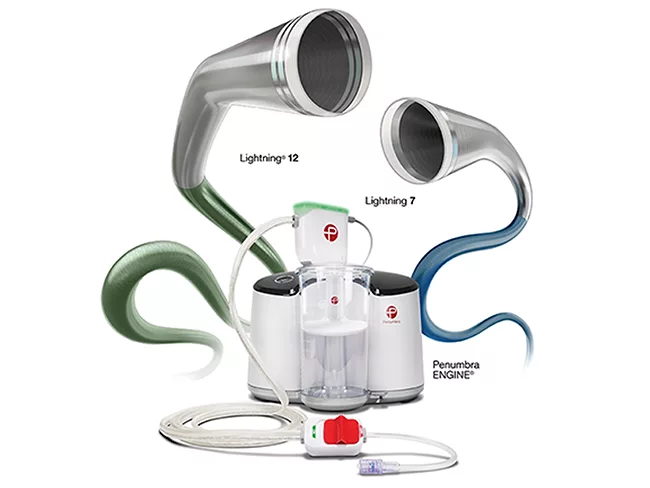
Penumbra Inc. presented new data at the LINC Symposium in Leipzig, Germany, evaluating its Indigo aspiration system for submassive pulmonary embolism (PE). The subgroup analysis evaluated performance outcomes of patients with main pulmonary artery (PA) emboli vs. discrete unilateral or bilateral PA emboli without main PA involvement. Data from the study suggests the system can be used effectively for both proximal and distal aspiration thrombectomy in the pulmonary arteries.
Grail LLC reported a new study with the U.K.’s NHS to assess the clinical utility of its Galleri multi-cancer early detection test (MCED) for reducing late-stage cancer diagnoses. Menlo Park, Calif.-headquartered Grail presented the study design during the American Society of Clinical Oncology (ASCO) meeting in Chicago. The randomized controlled trial will enroll 140,000 asymptomatic participants aged 50-77 living across England to determine if Galleri can find cancers at an early stage when they are less advanced.