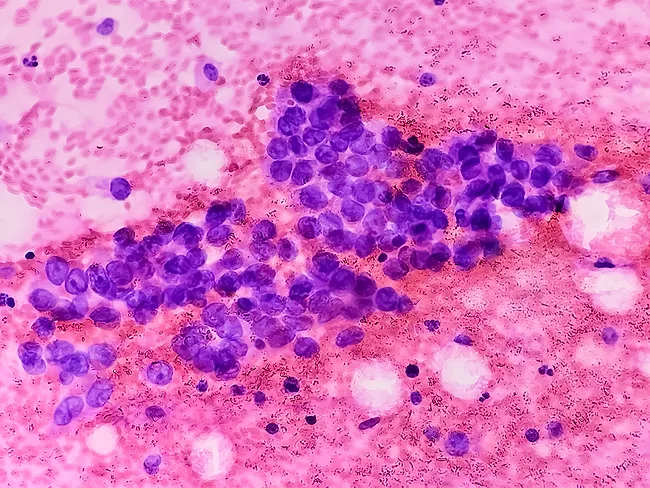
Researchers at Jilin University and collaborators combed through data in the public Cancer Genome Atlas and identified a potential target for lung adenocarcinoma.
Folate receptor α (FOLR1) is highly expressed in the surface of tumoral cells in several cancer types, while it shows limited expression in normal tissues. CSPC Pharmaceutical Group Ltd. has developed a next-generation antibody-drug conjugate (ADC) targeting FOLR1 – SYS-6041 – for the treatment of mid-to-low FOLR1-expressing tumors.
Drug resistance to epidermal growth factor receptor (EGFR) tyrosine kinase inhibitors, occurring via secondary mutations or bypass pathways, is frequent among non-small-cell lung cancer patients.
The expression of tissue factor (TF) is limited in normal tissues to the perivascular compartment where it acts as the receptor for the serin protease factor VIIa. This signaling axis triggers the initiation of extrinsic coagulation protease cascade.
Korea Research Institute of Chemical Technology has identified glutaminase inhibitors reported to be useful for the treatment of cancer and autoimmune diseases.
Formosa Pharmaceuticals Inc. and Almac Discovery Ltd. have announced a global licensing agreement for development and commercialization of ALM-401, a first-in-class engineered bispecific antibody-drug conjugate (ADC) for the treatment of solid tumors characterized by the dual expression of EGFR and ROR1.
The intriguing VEGFxPD-1 bispecific antibody space gained oomph with phase III results disclosed April 23 by Akeso Pharmaceuticals Inc. related to Harmoni-6, testing ivonescimab in combination with platinum-based chemotherapy compared with Tevimbra (tislelizumab, Beigene Ltd.), a PD-1 inhibitor also paired with platinum-based chemo in patients with locally advanced or metastatic squamous non-small-cell lung cancer irrespective of PD-L1 expression. Those data were followed by a green light from the U.S. FDA April 24 for marketing the PD-1 monoclonal antibody penpulimab in combination with cisplatin or carboplatin and gemcitabine for the first-line treatment of adult recurrent or metastatic non-keratinizing nasopharyngeal carcinoma.
HER3 overexpression in solid tumors is tied to poor prognosis, concretely in breast and non-small-cell lung cancers, where treatment resistance often occurs upon using targeted therapy, highlighting the need for novel targeted therapies against HER3. Since its expression is much higher in tumor than normal cells, HER3 is a robust candidate for antibody-drug conjugate (ADC) therapy.
The intriguing VEGFxPD-1 bispecific antibody space gained oomph with phase III results disclosed April 23 by Akeso Pharmaceuticals Inc. related to Harmoni-6, testing ivonescimab in combination with platinum-based chemotherapy compared with Tevimbra (tislelizumab, Beigene Ltd.), a PD-1 inhibitor also paired with platinum-based chemo in patients with locally advanced or metastatic squamous non-small-cell lung cancer irrespective of PD-L1 expression. Those data were followed by a green light from the U.S. FDA April 24 for marketing the PD-1 monoclonal antibody penpulimab in combination with cisplatin or carboplatin and gemcitabine for the first-line treatment of adult recurrent or metastatic non-keratinizing nasopharyngeal carcinoma.