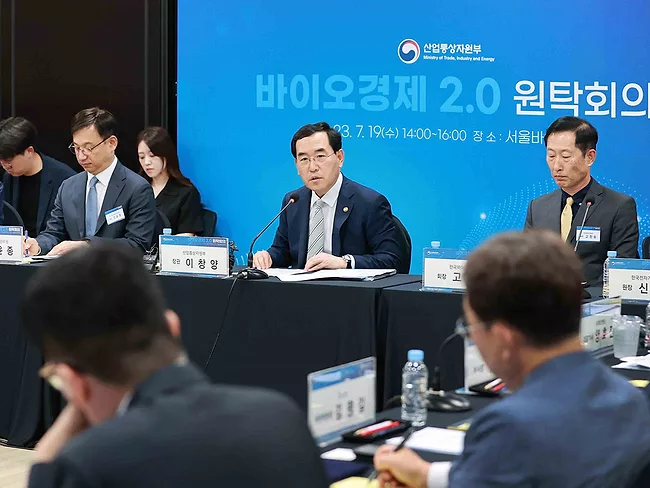
In July 2023, South Korea’s Ministry of Trade, Industry and Energy ramped up efforts to kickstart the so-called “Bio Economy 2.0,” the newfound initiative that banks on the biopharmaceutical industry to potentially revitalize the country’s slowing economic and social growth. Highlighting four major areas – biopharmaceuticals, biomaterials, bioenergy and digital technologies – as the four “wheels” to carry the biopharma industry, the new plan underscored the government’s unwavering support for the sector while highlighting its vision to become the “number one bioeconomy” worldwide.
In July 2023, South Korea’s Ministry of Trade, Industry and Energy ramped up efforts to kickstart the so-called “Bio Economy 2.0,” the newfound initiative that banks on the biopharmaceutical industry to potentially revitalize the country’s slowing economic and social growth. Highlighting four major areas – biopharmaceuticals, biomaterials, bioenergy and digital technologies – as the four “wheels” to carry the biopharma industry, the new plan underscored the government’s unwavering support for the sector while highlighting its vision to become the “number one bioeconomy” worldwide.
Thanks to a raft of new approvals by Japan’s Ministry of Health, Labor and Welfare (MHLW), patients in Japan will soon have access to Biogen Inc./Eisai Co. Ltd.’s Leqembi (lecanemab), an amyloid-beta binder, for slowing progression of mild cognitive impairment and mild dementia due to Alzheimer's disease.
If the U.S. FDA has its way, biosimilars and interchangeable biosimilars would no longer be a difference with a distinction – at least when it comes to labeling. Instead of distinguishing between the two, the agency is recommending that the labeling for both follow-ons include a “biosimilarity statement.”
Biosimilars continue to pose cheaper alternatives to their established, blockbuster counterparts. The U.S. FDA has approved Tyruko (natalizumab-sztn) from Sandoz Inc., the generics business of Novartis AG. It is the first approved biosimilar to Biogen Inc.’s blockbuster Tysabri (natalizumab), an injectable monoclonal antibody for treating adults with relapsing forms of multiple sclerosis (MS).
South Korea’s Celltrion Inc. is rolling out a tweaked plan to merge its three affiliates – electing for a two-way merger followed by consolidation with the final branch – in its latest efforts to rise through the ranks and emerge as a “true” big pharma.
South Korea’s Celltrion Inc. is rolling out a tweaked plan to merge its three affiliates – electing for a two-way merger followed by consolidation with the final branch – in its latest efforts to rise through the ranks and emerge as a “true” big pharma.
Nearly 13 years after Congress created a biosimilars path to bring competition to the U.S. biologics market, new rules of the road are coming into play, via the Inflation Reduction Act (IRA), that could change the course for biosimilars in the long haul – if the IRA’s prescription drug price negotiation mandate withstands numerous constitutional challenges.
One of the companies wanting to be part of the upcoming U.S. launch of Humira biosimilars is instead exploring options to raise additional capital so it can continue advancing its biosimilar pipeline in the near term. Alvotech Holdings SA, a pure-play biosimilars company based in Iceland, initially had hoped for FDA approval June 28 for AVT-02, developed as both an interchangeable and biosimilar to the high-concentration formulation (HCF) of Abbvie Inc.’s blockbuster autoimmune drug, Humira (adalimumab).
Manufacturing deficiencies stand in the way of two BLAs as complete response letters (CRLs) were issued to Eli Lilly and Co. and to Alvotech Holdings SA. The U.S. FDA issued the CRL to Lilly regarding the BLA for mirikizumab, a humanized IgG4 monoclonal antibody to treat ulcerative colitis, specifically citing manufacturing concerns. There’s a similar problem with Alvotech’s biosimilar candidate for Abbvie Inc.’s Humira (adalimumab). The FDA issued a CRL for AVT-02’s BLA, citing problems needing resolution at its Reykjavik, Iceland, manufacturing facility before it could approve the application.