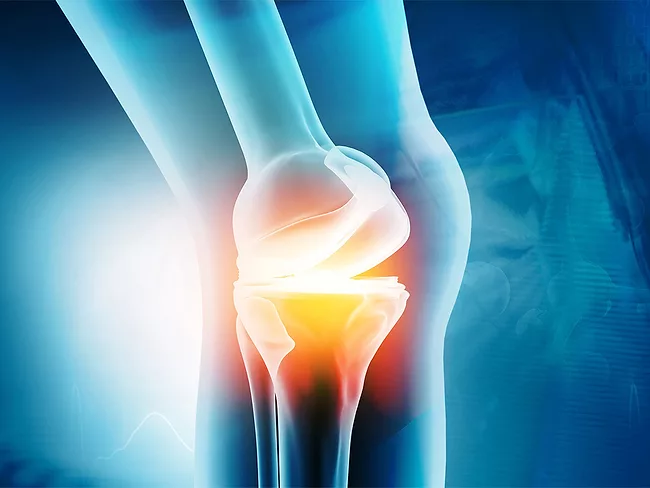
As it advances its nonopioid analgesic ATX-101 breakthrough therapy through a phase IIb registration trial, Allay Therapeutics secured $57.5 million in a series D round, which included an investment from the company’s Japanese partner.
As it advances its nonopioid analgesic ATX-101 breakthrough therapy through a phase IIb registration trial, Allay Therapeutics secured $57.5 million in a series D round, which included an investment from the company’s Japanese partner. ATX-101, a configuration of sodium ion channel blocker bupivacaine and a biopolymer, which is in a phase IIb registration study, is designed to offer pain relief following total knee arthroplasty.
A research team led by consultant and orthopedic surgeon Glen Liau Zi Qiang from Alexandra Hospital in Singapore developed a new AI algorithm to improve the accuracy and efficiency of robotic total knee arthroplasty (rTKA) surgery.
The U.K. National Institute for Health and Care Excellence sees some evidence that single-step insertions of scaffolds for knees with damaged cartilage offer significant benefits, calling for the use of registries for tracking of outcomes data.
New York-based Apos Medical Assets Ltd., doing business as Aposhealth, has been developing a shoe that provides some relief from pain and disability in patients who are candidates for total knee arthroplasty (TKA), and the Apos shoe seems to have gained a toehold in the U.K. market. The National Institute for Health and Care Excellence (NICE) has provided a guarded recommendation for the use of the Apos shoe in the U.K., although the agency still has questions as to how long use of the shoe can delay the need for TKA.
Ganymed Robotics SAS raised a €21 million (US$21.2 million) series B round to develop its robotic system for total knee arthroplasty (TKA). Health care fund Cathay Health led the round, with participation from Credit Mutuel Innovation, Kurma Partners, BNP Paribas Developpement, and individual surgeons. The funds will be used to finalize development of Ganymed’s TKA surgical assistant and support the company’s expansion in France and the U.S.
The NMPA approved two different surgical robots for marketing, a step forward in growth of a sector that remains underdeveloped in China. One of the robots approved for marketing by the NMPA is from Yuanhua Orthopedic Robotic Ltd. and the other is Suzhou Microport Orthobot Co. Ltd. Both robots are used for total knee arthroplasty (TKA), removing damaged cartilage and bones from the surface of the knee joint and replacing them with artificial implants.
Medical science has not yet convincingly duplicated the remarkable properties of cartilage, an omission that sustains an epidemic of life-altering knee replacement surgeries. Anthony Ratcliffe, CEO of Synthasome Inc., of Del Mar, Calif., said on a recent FDA webinar that companies might want to consider the lowly goat as the animal model of choice in preclinical studies of cartilage products because “the cost, ease of management, and the social aspects were all manageable” with goats.
Digital health has made only limited headway in the orthopedics space, but Zimmer Biome Inc. and Canary Medical Inc. have nudged the cause along with a smart implant that blends a 21st century sensor with a traditional knee replacement device. The marriage of Zimmer’s Persona knee implant and the Canary Medical Canturio TE sensor will give physicians a better way to track the patient’s recovery from knee replacement procedures.
PARIS – Ganymed Robotics SAS reported the successful completion of functional prototype testing for its surgical robotic assistant used in total knee arthroplasty. According to a systematic review of the literature, published in the Journal of Arthroplasty, more than 2 million patients undergo knee arthroplasty each year after suffering arthritis of the knee.