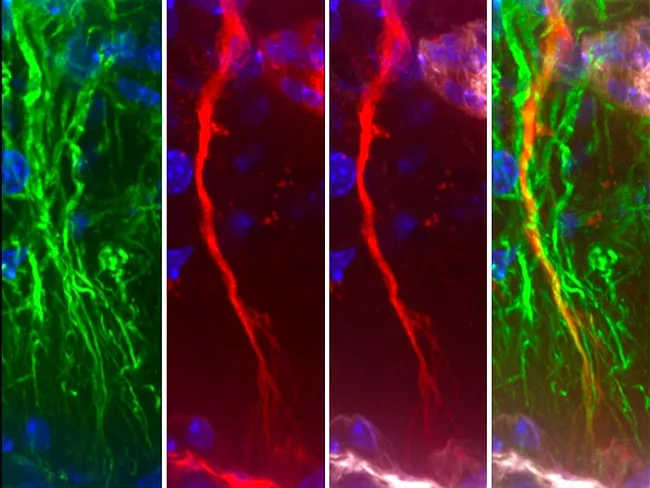
Researchers at INSERM and collaborators have identified hypothalamic tanycytes as mediators of tau clearance and shown that their structural and genetic disruption may drive Alzheimer’s disease pathology.
Researchers at INSERM and collaborators have identified hypothalamic tanycytes as mediators of tau clearance and shown that their structural and genetic disruption may drive Alzheimer’s disease (AD) pathology. AD is characterized by the buildup of extracellular amyloid-β plaques and intracellular tau tangles, protein aggregates that disrupt neuronal function and drive neurodegeneration.
M-3554 is an antibody-drug conjugate (ADC) targeting GD2; it has shown strong antitumor activity in neuroblastoma xenograft models and has been engineered to reduce anti-GD2 antibody-associated pain.
Scientists from INSERM and affiliated organizations presented findings from their work that aimed to investigate the involvement of heat shock protein 27 (HSP27) in the activation and pathological accumulation of parietal epithelial cells (PEC) during crescentic glomerulonephritis (CrGN).
The abscopal effect occurs when therapy leads to the regression of metastases distant from the target tumor. In the current study, researchers from INSERM aimed to evaluate the abscopal effect potentially inducted by the use the targeted radionuclide therapy (TRT) candidate, [131I]ICF-01012, which has been previously shown to target only pigmented metastases.
Researchers at Centre National de la Recherche Scientifique (CNRS), Institut National de la Santé et de la Recherche Médicale (INSERM) and Université Côte d'Azur have divulged amidinourea derivatives reported to be useful for the treatment of cancer, in particular for BRAF inhibitor-resistant melanoma.
Scientists at Centre Hospitalier Regional Universitaire de Lille, INSERM and University of Lille have divulged diphenylpyrazole compounds acting as β-amyloid (Aβ) production inhibitors and autophagy marker ratio modulators reported to be useful for the treatment of Alzheimer’s disease.
Researchers at Biodol Therapeutics SAS, Centre National de la Recherche Scientifique, INSERM and Université de Strasbourg have divulged new n-heteroarylbenzamide derivatives acting as FLT3 (FLK2/STK1) inhibitors and reported to be useful for the treatment of pain.
Researchers from Centre National de la Recherche Scientifique, Inserm, Université Claude Bernard and Université Jean Monnet have synthesized peptides acting as amyloid-β (Aβ) protein aggregation inhibitors reported to be useful for the treatment of amyotrophic lateral sclerosis, cerebral amyloid angiopathy, Down syndrome, Parkinson's disease, Alzheimer's disease and motor neuron disease.
AGV Discovery SAS, in collaboration with scientists from Centre National de la Recherche Scientifique, Inserm and Universite de Montpellier, divulged azaindole derivatives acting as extracellular-regulated kinase (ERK) inhibitors, particularly ERK2, reported to be useful for the treatment of cancer, inflammation, autoimmune disease, substance abuse and dependence, metabolic syndrome, neurodegeneration, HIV infection, and pain, among other disorders.