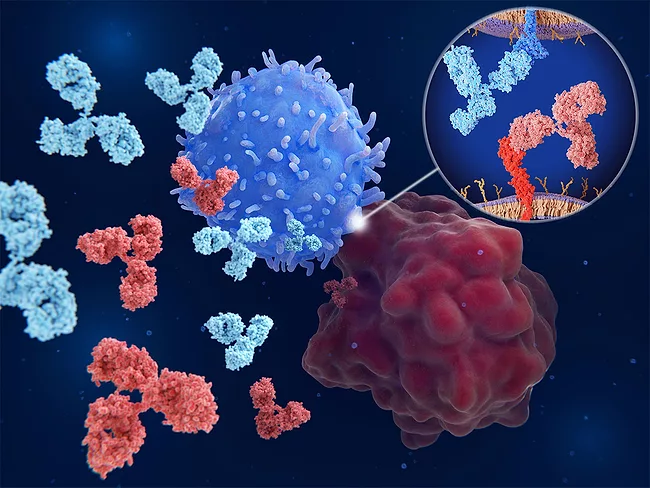
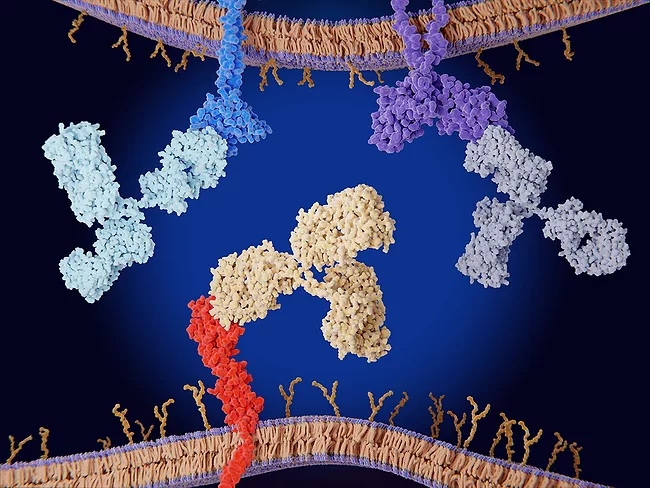
The adverse effects of PD-1 blockers on the CNS observed in cancer patients could occur through their effects on an enzyme that activates microglia. Pharmacological inhibition of the enzyme in mice reduced microglial activation and cognitive deficit without altering the antitumor capacity of the immunotherapy.
Pheast Therapeutics Inc. has announced the presentation of preclinical data for PHST-001, a therapeutic monoclonal antibody targeting CD24, a macrophage checkpoint.
China’s National Medical Products Administration has cleared Immuneonco Biopharmaceuticals Co. Ltd.’s’ IMM-01 (timdarpacept) to enter a pivotal phase III trial in combination with Beigene Co. Ltd.’s PD-1 inhibitor, tislelizumab, in relapsed or refractory classical Hodgkin lymphoma patients who relapsed or progressed after treatment with PD-1 inhibitors.
Immuneoncia Therapeutics Inc., a joint venture between South Korea’s Yuhan Corp. and San Diego-based Sorrento Therapeutics Inc., is looking to list on the Korea Exchange, having recently passed local technology evaluation.
China’s National Medical Products Administration has cleared Immuneonco Biopharmaceuticals Co. Ltd.’s’ IMM-01 (timdarpacept) to enter a pivotal phase III trial in combination with Beigene Co. Ltd.’s PD-1 inhibitor, tislelizumab, in relapsed or refractory classical Hodgkin lymphoma patients who relapsed or progressed after treatment with PD-1 inhibitors.
Immuneoncia Therapeutics Inc., a joint venture between South Korea’s Yuhan Corp. and San Diego-based Sorrento Therapeutics Inc., is looking to list on the Korea Exchange, having recently passed local technology evaluation.
Conformation-X Therapeutics LLC has closed an oversubscribed funding tranche of $3.65 million to support the company’s development of a pipeline of immunotherapies that activate both the innate and adaptive arms of the immune system.
In recent years, the introduction of immune checkpoint inhibitors to the oncolytic pipeline has been a significant breakthrough in cancer treatment, but unfortunately some tumors respond only minimally. Besides CTLA-4, and since the approval of PD-1/PD-L1 inhibitors, only the anti-LAG3 strategy (relatlimab, Bristol Myers Squibb Co.) has been good enough to reach the market. In a session dealing with emerging checkpoints beyond PD-1, CTLA-4 and LAG3, Drew Rasco from the START Center for Cancer Care depicted a new player on the ground of immunotherapeutic options.
Researchers from Panolos Bioscience Inc. and affiliated organizations have published preclinical data for PB-101, a novel glycosylated decoy protein targeting both vascular endothelial growth factor (VEGF) and placental growth factor (PlGF).
Researchers from Westlake Therapeutics (Hangzhou) Co. Ltd. have presented the discovery and preclinical evaluation of a novel erythrocyte-anti-PD-1 antibody conjugate, WTX-212, being developed for the treatment of cancer.