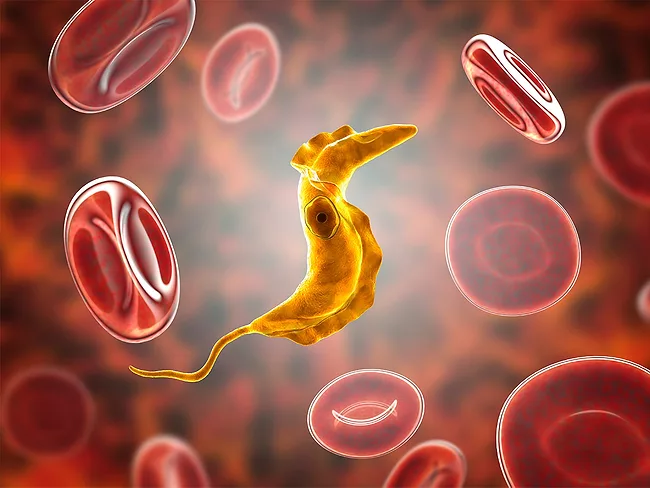
Novartis AG has synthesized cyanotrizole compounds reported to be useful for the treatment of leishmaniasis, American trypanosomiasis (Chagas disease) and African trypanosomiasis (sleeping sickness).
Visceral leishmaniasis is a fatal disease caused by the Leishmania parasite, affecting organs such as the liver and spleen. Visceral leishmaniasis is considered a neglected tropical disease and is estimated to cause between 50,000 and 90,000 cases and around 70,000 deaths per year.
Leishmaniasis is a life-threatening parasitic infection and one of the most concerning neglected vector-borne tropical diseases worldwide. Current leishmaniasis chemotherapeuticals are poorly effective and cause significant adverse effects. Metal-containing drugs have been little explored as antibacterial and antiparasitic agents, although some have shown promise against Leishmania.
Researchers from Universidade Estadual da Paraíba, Universidade Federal da Paraiba and affiliated organizations presented the design, synthesis and bio-evaluation of new small-molecule candidates for the treatment of leishmaniasis, a neglected tropical disease that affects approximately 12 million people in four continents.
McGill University, Université de Montreal, Yeda Research and Development Co. Ltd. and Yissum Research Development Co. have jointly developed anisomycin analogues reported to be useful for the treatment of giardiasis, leishmaniasis, toxoplasmosis and trypanosomiasis.
Leishmaniasis is a vector-borne infectious disease caused by several protozoan Leishmania species with diverse clinical manifestations and limited treatment options to date. Researchers at Drugs for Neglected Diseases initiative have reported on the discovery and preclinical characterization of DNDI-6174, a novel inhibitor of the Leishmania cytochrome bc1 complex.
Central Drug Research Institute investigators have synthesized novel compounds conjugating the quinoline moiety with a piperazine/pyrrolidine scaffold through a molecular hybridization approach and investigated their antileishmanial activity.
Sandfly bites transmit the intracellular protozoan Leishmania to cause leishmaniasis that exhibits with clinical presentations ranging from a cutaneous ulcer to treatment-resistant lethal systemic disease (visceral leishmaniasis; VL). VL reportedly kills 20,000 to 30,000 every year according to the World Health Organization, where current medications are limited by side effects and evolving antibiotic resistance. Accordingly, there is a great need to develop alternatives.
Parasitic diseases caused by trypanosomatid protozoa have long been treated with traditional methods. However, the effectiveness of current treatments for leishmaniasis is limited. Some are toxic, or have been abandoned, such as in the cases of Chagas disease and human African trypanosomiasis (HAT), commonly known as sleeping sickness.