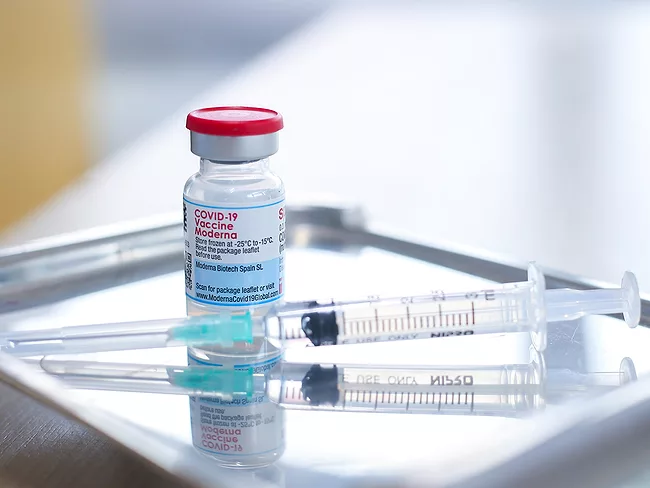
Now there are three. Moderna Inc. has posted strong phase III study data on its mRNA respiratory syncytial virus (RSV) vaccine, keeping pace with Pfizer Inc. and GSK plc’s candidates, which have May PDUFA dates. Moderna’s top-line results of the ConquerRSV pivotal efficacy study of mRNA-1345 show the vaccine hit its primary efficacy endpoints of 83.7% against RSV-associated lower respiratory tract disease in older adults.
Sen. Bernie Sanders (I-Vt.), the incoming chair of the U.S. Senate Health, Education, Labor and Pensions (HELP) Committee, penned a blistering letter that takes Moderna Inc. CEO Stéphane Bancel to task over the company’s plans to more than quadruple the U.S. list price of its COVID-19 vaccine once the government’s supply is depleted.
Once a rarity, billion-dollar deals are now coming fast and furious. Now three have appeared in only a few days. Gene therapy developer Voyager Therapeutics Inc. and Neurocrine Biosciences Inc. continued a longstanding partnership by agreeing to develop treatments for neurological diseases and for three new programs with rare CNS targets. Cytomx Therapeutics Inc. and Moderna Inc. entered a deal worth a potential $1.24 billion to Cytomx for generating and developing treatments in oncology and non-oncology. In the third deal, Royalty Pharma plc acquired an interest in Ionis Pharmaceuticals Inc.'s royalty in Biogen Inc.'s Spinraza (nusinersen) and Novartis AG's pelacarsen for up to $1.125 billion.
Vertex Pharmaceuticals Inc. has received clearance from the FDA for its IND application for VX-522, a messenger ribonucleic acid (mRNA) therapy targeted at treating the underlying cause of cystic fibrosis (CF).
Nona Biosciences Co. Ltd., a subsidiary of Harbour Biomed Therapeutics Ltd. launched in November to provide “idea to IND” services, has struck a deal with Moderna Inc. to develop nucleic acid-based immunotherapies. The candidates will be based on Harbour’s heavy chain only antibody discovery platform.
Nona Biosciences Co. Ltd., a subsidiary of Harbour Biomed Therapeutics Ltd. launched in November to provide “idea to IND” services, has struck a deal with Moderna Inc. to develop nucleic acid-based immunotherapies. The candidates will be based on Harbour’s heavy chain only antibody discovery platform.
It was a busy day at Moderna Inc. as Merck & Co. Inc. exercised its option to jointly develop and commercialize a personalized cancer vaccine with Moderna in a deal the two companies inked in 2016. Moderna also notched another emergency use authorization (EUA) for its COVID-19 vaccine, this one targeting the omicron variant, for use by those under age 18.
Proof of concept has been achieved for a therapy for argininosuccinic aciduria consisting of human argininosuccinic lyase (ASL) mRNA encapsulated in lipid nanoparticles (ASL-LNPs).
In the hope of preventing thousands of hospitalizations and deaths over the next few months, the U.S. CDC’s Advisory Committee on Immunization Practice (ACIP) voted 13-1 Sept. 1 to recommend the use of Moderna Inc.’s and Pfizer Inc.-Biontech SE’s updated vaccines that contain components of both the original SARS-CoV-2 virus and the omicron BA.4/5 subvariants as boosters.
Right on cue, the U.S. FDA authorized bivalent COVID-19 vaccines from Moderna Inc. and Pfizer Inc.-Biontech SE to be given as boosters at least two months following a primary vaccine series or a previous booster. “These updated boosters present us with an opportunity to get ahead of the next wave of COVID-19,” FDA Commissioner Robert Califf said, following the Aug. 31 announcement.