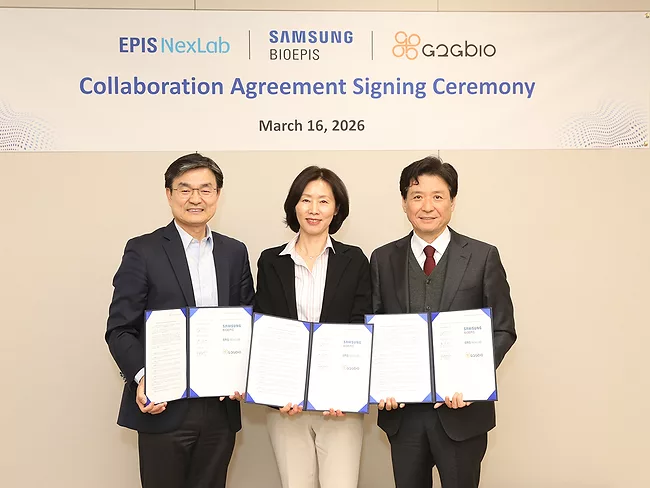
G2Gbio Inc. secured a ₩20 billion (US$13.35 million) investment from Samsung Epis Holdings Co. Ltd. and a joint research and license agreement for two assets, including a long-acting obesity treatment, with subsidiary Samsung Bioepis Co. Ltd. March 16.
G2Gbio Inc. secured a ₩20 billion (US$13.35 million) investment from Samsung Epis Holdings Co. Ltd. and a joint research and license agreement for two assets, including a long-acting obesity treatment, with subsidiary Samsung Bioepis Co. Ltd. March 16.
The Sept. 4, 2015, at-risk launch of Sandoz Inc.’s Zarxio as the first biosimilar to hit the U.S. market came several months after the FDA had approved the filgrastim biosimilar due to a court battle over the requirements of the 2010 Biologics Price Competition and Innovation Act, which laid out the rules of the road for the new class of follow-on drugs. Ten years later, biosimilar developers are still struggling with some of those rules that were drafted by Congress in an effort to balance competition with innovation in the biologics space. Insulin biosimilars may be the hardest hit.
Phrontline Biopharma Suzhou Co. Ltd. closed a $60 million pre-A+ financing round led by Lapam Investment, with participation from nine other investors. The funds raised will support Phrontline’s development of next-generation antibody-drug conjugate (ADC) candidates.
It’s been a decade since Sandoz Inc. launched Zarxio, referencing Amgen Inc.’s Neupogen (filgrastim), as the first biosimilar in the U.S. Zarxio was expected to be the beginning of a biosimilar boom that would deliver big savings by finally providing direct competition for costly biologics. Neither the pipeline nor the uptake of biosimilars has lived up to expectations, as only 6% of the 313 biologics approved by the FDA’s CDER have been targeted by biosimilars and fewer than 5% are actually competing with the follow-ons.
Two South Korean conglomerates – Samyang Holdings Corp. and Samsung Biologics Co. Ltd. – listed their newly spun-off biopharmaceutical units on Korea Exchange’s (KRX) main trading board Nov. 24.
Two South Korean conglomerates – Samyang Holdings Corp. and Samsung Biologics Co. Ltd. – listed their newly spun-off biopharmaceutical units on Korea Exchange’s (KRX) main trading board Nov. 24.
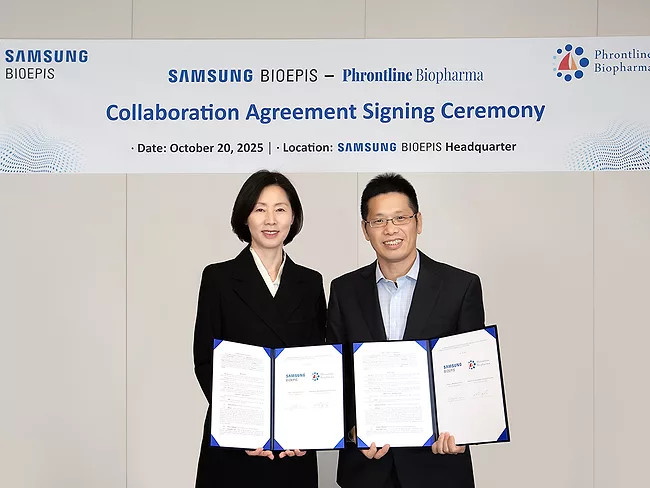
Samsung Bioepis Co. Ltd. announced Oct. 21 the signing of a license deal to codevelop, manufacture and commercialize two of Phrontline Biopharma Suzhou Co. Ltd.’s novel bispecific dual-payload antibody-drug conjugate (ADC) candidates.
Three milestones expected to bring the reality of U.S. prescription drug price negotiations into focus are hovering on the horizon. First, the CMS is scheduled to publish its maximum fair prices (MFPs) for the round 2 selected drugs by Nov. 30. Then, on Jan. 1, the MFPs for the first round kick in, affecting not only the 10 selected drugs, but a dozen approved biosimilars referencing the three biologics in that round, 94 generics either approved or tentatively approved that reference the small molecules on the list, and perhaps other innovator drugs in the same therapeutic spaces. And by Feb. 1, CMS must publish the list of up to 15 drugs selected for negotiations for the 2028 price year. That list will be the first to include Part B drugs.
Location, location, location. While location is as important in manufacturing as it is in buying a home, it could become even more so for drug companies when, and if, the global biopharma sector tariff U.S. President Donald Trump continues to tease becomes a reality. In the shadow of the impending tariff, the FDA is working on a draft framework, the two-phase FDA PreCheck, to make it faster and easier for biopharma companies to relocate their manufacturing to the U.S.