In the first quarter of 2025, the med-tech sector saw a total of $149.08 million raised through 475 deals. This marked a significant decline from the $519.14 million raised in Q4 2024, representing the smallest quarterly total recorded by BioWorld MedTech since 2018.
The trend of corporate pruning in med tech continues with Solventum Corp.’s decision to sell its purification and filtration business to Thermo Fisher Scientific Inc. for $4.1 billion. The announcement follows two other big company splits already in 2025: Baxter International Inc.’s separation of its kidney unit as Vantive, bought by Carlyle Group Inc. for $3.8 billion, and Stryker Corp.’s planned sale of its spinal implants business to Viscogliosi Brothers LLC.
In a remarkably news-filled earnings call on Jan. 28, Stryker Corp. revealed plans to sell its U.S. and spinal implants business to Viscogliosi Brothers LLC for an undisclosed sum, announced the retirement of Chief Financial Officer Glenn Boehnlein on April 1, reported sales growth of 11% for the fourth quarter and 10% for the full year 2024 and said the $4.9 billion acquisition of Inari Medical Inc. should close by the end of February.
With multiple large M&A deals already announced in January, CEOs of major med-tech companies outlining acquisition plans for 2025 and declining interest rates, the stage is set for a significantly more active year of M&A. Financings, too, have ticked up and analysts expect the trend to continue, offering hope for a positive year for the med-tech industry.
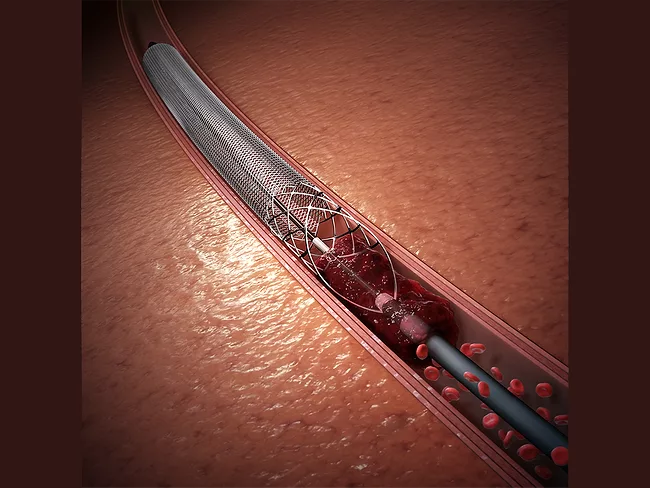
With more than 60 acquisitions completed in the last decade, Stryker Corp. shows little fear in committing to offers that allow it to obtain the companies and technologies that have driven its impressive growth in stock price – up from $92 in Jan. 2015 to $356.70 in Jan. 2025. Still, the definitive agreement to buy Inari Medical Inc. for $4.9 billion comes in at the upper range, along with the $4 billion acquisition of Wright Medical Group NV in 2020 ($5.4 billion with debt included), $3 billion for Vocera Communications in 2022, and $2.8 billion for Sage Products in 2016.
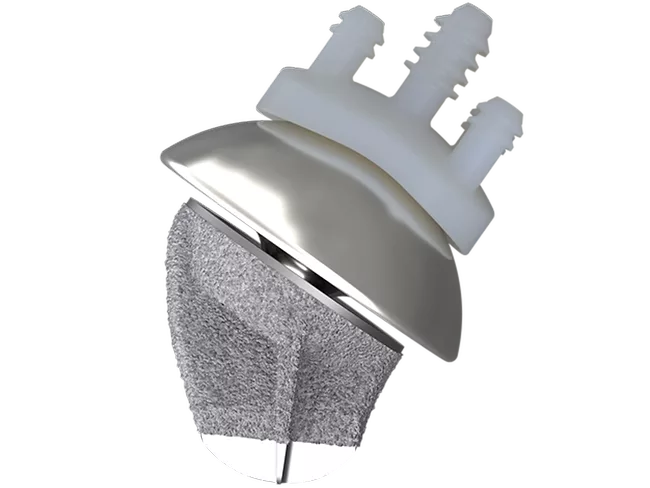
Smith & Nephew plc received U.S. FDA 510(k) clearance for Aetos Stemless, its stemless anatomic total shoulder implant. The greenlight for the device is a boon for the company’s orthopedics portfolio, which faces increasing pressure from U.S. competitors.
Stryker Corp. continued its aggressive M&A program this year with the planned acquisition of Vertos Medical Inc. Vertos offers a minimally invasive lumbar decompression (Mild) solution for chronic lower back pain caused by lumbar spinal stenosis. The announcement brings Stryker to six deals so far this year: Société d'Etudes, de Recherches et de Fabrication (SERF) SAS, Mfphd LLC, Artelon Inc., Molli Surgical Inc., Care.ai Inc. and now Vertos. Financial terms were not disclosed for any of the transactions.
Stryker Corp. continued its recent buying spree with the purchase of Molli Surgical Inc., a company that develops wire-free soft tissue localization technology for breast-conserving surgery. Styker said Molli’s offerings strengthen its advancing surgical solutions in breast cancer care.
Vyaire Medical Inc., of Mettawa, Ill., reported a class I recall of its Twin Tubes devices, which are used in the collection of air samples during cardiopulmonary exercise testing. The recall was prompted by the risk that the device nozzle will separate during patient use and potentially result in choking, although the FDA said there have been no reports of adverse events in connection with the problem.
Investors bailed on many med-tech companies last year, fearing that the frenzy surrounding GLP-1 agonists would tank companies in the weight-loss, diabetes and orthopedics segments. Their concerns now appear overblown in many instances, with some of the most directly affected businesses reporting a “rising tide” associated with an increased focus on obesity treatment that has lifted their boats rather than sinking them.