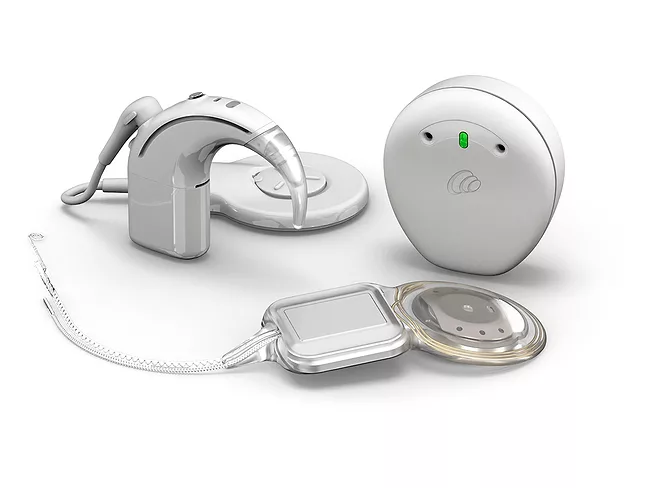
Shares in Aussie hearing implant maker Cochlear Ltd. plummeted nearly 39% April 22 after the company slashed fiscal 2026 earnings guidance and warned that weaker-than-expected demand in developed markets was exposing a more cyclical and discretionary side to its business than investors had assumed.
The U.S. FDA and CMS are teaming up to give Medicare beneficiaries quicker access to breakthrough medical devices and provide manufacturers with certainty of reimbursement.
Total med-tech financings reached $8.81 billion in the first quarter (Q1) 2026, a 6% decline from $9.33 billion in Q1 2025 but well above the post-downturn lows of recent years.
Total med-tech financings reached $8.81 billion in the first quarter (Q1) 2026, a 6% decline from $9.33 billion in Q1 2025 but well above the post-downturn lows of recent years. The 2026 total exceeds $6.45 billion in Q1 2024 and $4.69 billion in Q1 2023, indicating continued recovery from the weaker funding environment that followed the 2021 peak. While still below the $16.59 billion recorded in Q1 2019 and the pandemic-era highs, the data suggest that financing activity has stabilized at a higher baseline, with 2026 maintaining momentum despite a slight year-over-year pullback.
Despite key vacancies, ongoing staffing challenges and policy issues at the U.S. CDC, FDA and NIH, some of the regulatory churn that roiled those agencies in the first year of the second Trump administration is settling a bit, at least in terms of the number of executive orders (EOs) coming out of the Oval Office.
Med-tech M&A activity surged in March 2026, with deal value reaching $23.66 billion, the highest monthly total since June 2022’s $36.27 billion and a sharp increase from $17.53 billion in February and $1.69 billion in January.
Total med-tech financings reached $8.54 billion in the first quarter (Q1) of 2026, reflecting a modest pullback from $9.33 billion in the same period of 2025 but remaining well above previous years. The Q1 2026 total exceeds the $6.45 billion recorded in Q1 2024 and $4.69 billion in Q1 2023, signaling continued recovery from the post-2021 downturn.
Don’t like a court order? Sidestep it. That seems to be the idea behind U.S. Health and Human Services Secretary Robert Kennedy’s latest changes to his renewal of the charter for the CDC’s Advisory Committee on Immunization Practices (ACIP).
Med-tech deal value, excluding M&As, totaled $628.41 million in the first quarter (Q1) of 2026, an increase of about 322% from the $149.08 million recorded in Q1 2025 though a 36% drop from Q4 2025‘s $978.58 million.
With all the focus of late on the U.S. CDC’s Advisory Committee on Immunization Practices (ACIP), the FDA’s 30-plus advisory committees have been flying under the radar, especially since many of them haven’t met for a few years now.
 RSS
RSS