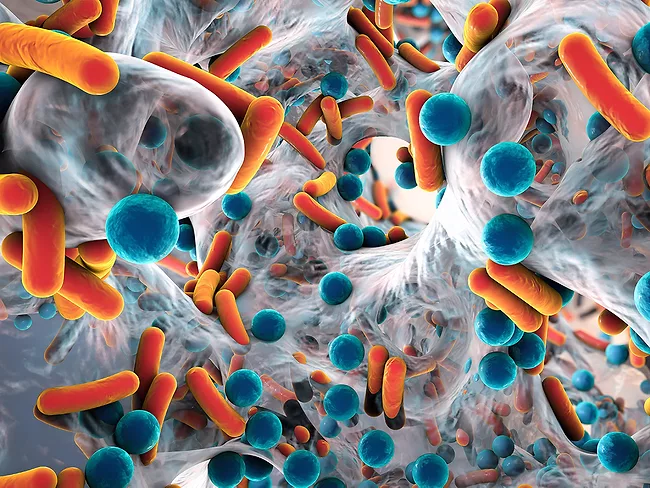
Bacteria cells are masters of adaptation and evolution, and by better understanding how they adapt and evolve, researchers hope to develop better drugs to fight microbial resistance, which is increasingly becoming a global public health threat. Researchers from the antimicrobial resistance interdisciplinary research group at the Singapore-MIT Alliance for Research and Technology (SMART) sought to understand the mechanisms bacteria use to adapt against stressors, and they discovered a new stress signaling system that sheds light on a new mechanism of antimicrobial resistance.
Researchers at the Barcelona Institute of Science and Technology’s Center for Genomic Regulation (CRG) and Pulmobiotics Ltd. have used one bacterium to fight another. In mouse models, the team used engineered Mycoplasma pneumoniae to treat Pseudomonas aeruginosa, the chief culprit in ventilator-associated pneumonia (VAP).
When a drug prevents bacteria from synthesizing their own folate, an essential compound for their survival, they take it directly from the host. This antibiotic resistance mechanism had not been detected until now because bacteria behave differently in the laboratory than they do in vivo during an infection.
P-glycoprotein (P-gp) is a multidrug resistance (MDR)-associated protein, which is widely distributed in membranes of several cells including hepatocytes, renal proximal tubular cells and brain capillary endothelial cells. The overexpression of this drug efflux transporter protein is considered to play a key role in the development of MDR.
While simultaneous targeting of PD-1 and TGF-β has been previously suggested to be a favorable strategy to reverse immune checkpoint inhibitor (ICI) resistance of tumors, the hydrophobicity of TGF-β inhibitors and latent drug-related adverse events of this treatment hindered its utility.
Scientists from the University of Queensland have created a new antibiotic that can neutralize various gram-positive bacteria in mice, including major threats such as methicillin-resistant Staphylococcus aureus (MRSA). In a recent study, published in the Sept. 14, 2022, issue of Science Translational Medicine, the new compound outperformed the approved antibiotic vancomycin, and destroyed tough-to-eradicate bacterial biofilms while prompting a low rate of resistance.
GSK plc scientists seeking compounds with the potential to treat resistant tuberculosis infection identified a series of tetrazole agents using phenotypic screening against Mycobacterium tuberculosis.

 RSS
RSS