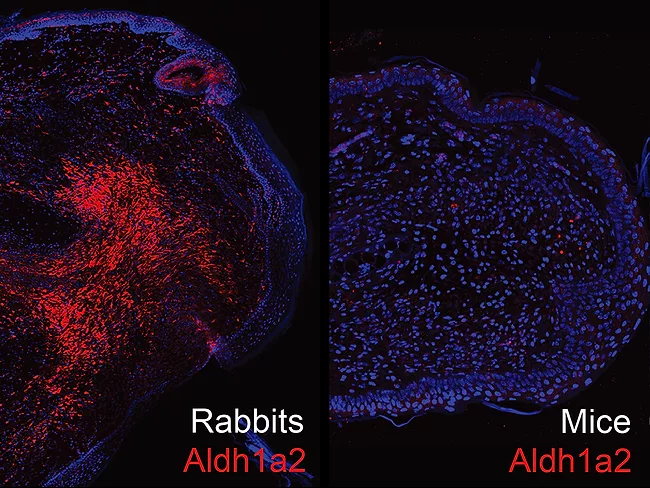
Lizards, zebrafish, salamanders and tritons can regrow a tail, a fin, or even an entire limb after amputation. Cut a planarian into pieces, and you will end up with a bunch of them. Researchers at the National Institute of Biological Sciences in Beijing have discovered a genetic switch linked to vitamin A. After activating this pathway, they managed to regenerate the ear pinna of a mouse, an animal that previously lacked this ability.
Lizards, zebrafish, salamanders and tritons can regrow a tail, a fin, or even an entire limb after amputation. Cut a planarian into pieces, and you will end up with a bunch of them.
Pathogenic variants in the GJB2 gene are the most common genetic cause of congenital sensorineural hearing loss and are mostly associated with an autosomal recessive non-syndromic deafness 1A (DFNB1A).
Eosinophilic otitis media (EOM) is a type 2-related otitis media. Scientists at the Hirosaki University Graduate School of Medicine have developed a new EOM animal model in guinea pigs by using the plant protease papain. Papin was intratympanically administered in a daily basis. They also investigated the expression of innate lymphoid cell type 2 (ILC2) in the middle ear mucosa of these animals.
Lysine demethylase 6A (KDM6A) is a demethylase that plays a key role at regulating developmental gene expression signatures in several tissues, including neuronal cells. The KDM6A gene is located in chromosome X and pathogenic variants in this gene are tied to Kabuki syndrome type 2. Even though progress in understanding the functions of KDM6A has been made, its role in cochlear development and auditory function remains poorly understood.
Researchers from Medical University of Vienna and affiliated organizations have presented findings from a study that aimed to assess the perilymph and tissue distribution of AC-102, a small and lipophilic intratympanically delivered pyridoindole derivative, in clinical development at Audiocure Pharma GmbH for the treatment of idiopathic sudden sensorineural hearing loss.
Aminoglycoside antibiotics are essential for treating some severe bacterial infections but are notorious for causing irreversible hearing loss in 20%-47% of patients.
Family with sequence similarity 19 member A5 (FAM19A5) is a secretory protein highly expressed in the brain that regulates synapse dynamics through its interaction with leucine-rich repeat-containing 4B (LRRC4B). Noise exposure is one of the most significant causes of synapse loss between inner hair cells and auditory nerve fibers, leading to a decline in hearing sensitivity.
The most common form of hereditary deafness in humans is caused by mutations in the GJB2 gene, which encodes the gap junction protein connexin 26. That regulates the transport of potassium and metabolites between inner ear cells. The coding sequence of this gene fits in an adenovirus-associated vector (AAV), making it an attractive approach for gene therapy.
In Regeneron Pharmaceuticals Inc.’s phase I/II Chord study of 12 children with genetic hearing loss, 10 out of 11 have shown improvements after being treated with a gene therapy. “What is really remarkable about this type of therapeutic approach is that the first people who are going to see the impact are not actually the physicians – it’s the families,” Jonathon Whitton, vice president and Regeneron’s auditory global program head, told BioWorld.
 RSS
RSS