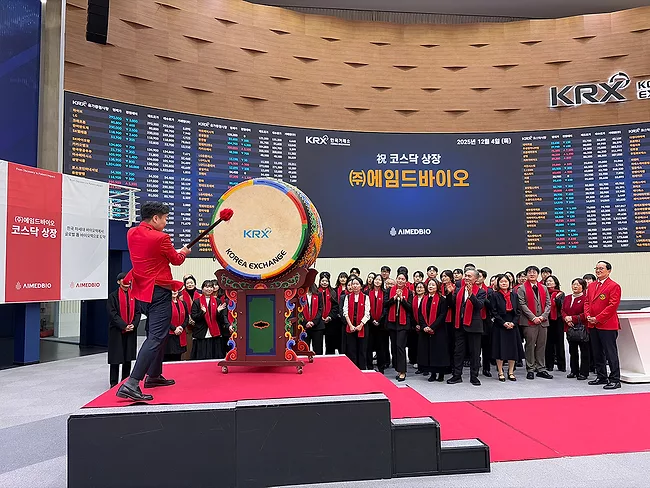
Multi-modality platform company Kanaph Therapeutics Inc. raised ₩40 billion (US$26.7 million) through its Kosdaq stock sale March 16, becoming the first Korean biotech to go public this year. The Seoul-based company’s shares (KOSDAQ:0082N0) climbed to ₩70,000 in intraday trading before closing at ₩50,600 – 153% higher than the offering price.
Two biotech and three med-tech companies are slated for Kosdaq debuts this month, signaling a potential rebound for Korea financings in 2026. Kanaph Therapeutics Inc. will open with a ₩40 billion (US$26.99 million) raise and Imbiologics Corp. will debut with ₩52 billion. Additionally, Mezoo Co. Ltd., Cosmo Robotics Co. Ltd. and Recensmedical Inc. will launch IPOs.
In a boon for licensee Bristol Myers Squibb Co., Systimmune Inc.’s next-generation cancer drug, izalontamab brengitecan (iza-bren), hit both progression-free survival and overall survival endpoints in a phase III trial of Chinese patients with advanced triple-negative breast cancer.
Galux closed a ₩42 billion (US$29 million) series B round Feb. 10, led by Yuanta Investment to bring AI-driven “rational design” to the protein drug development process, already heavily influenced by human engineering.
Shionogi & Co. Ltd. and Fosun Pharmaceutical (Group) Co. Ltd. were involved in separate divestment transactions this week, with Shionogi buying out Pfizer Inc.’s stake in Viiv Healthcare Ltd. to lift its holding to 21.7%.
U.S. policy, China’s strategic rise, blockbuster deals and AI dominated South Korea’s biotechnology industry this year, with U.S. tariffs and the Biosecure Act’s hitch onto 2026 legislation serving as major topics of speculation.
Speed and innovation from Asia Pacific’s (APAC) biotechnology sector had big pharma scouring the region for the next oncology heir to Keytruda (pembrolizumab), Merck & Co. Inc.’s reigning blockbuster cancer drug.
Daiichi Sankyo Inc. told BioWorld it voluntarily placed a partial hold in recruitment and enrollment in the phase III IDeate-Lung02 study of antibody-drug conjugate ifinatamab deruxtecan because of a higher than anticipated incidence of grade 5 interstitial lung disease events. The company did not say how many deaths there had been.
Crescent Biopharma Inc. teamed with Sichuan Kelun-Biotech Biopharmaceutical Co. Ltd. to generate “parallel” data of its PD-1/VEGF bispecific antibody, CR-001. The goal is to get 2027 readouts of the bispecific as a monotherapy and as a combination therapy with antibody-drug conjugates in both the U.S. and China.
 RSS
RSS