Takeda Pharmaceutical Co. Ltd. agreed to codevelop and commercialize up to three of Innovent Biologics Co. Ltd.’s immuno-oncology (I-O) and antibody-drug conjugate (ADC) candidates with the signing of a $11.4 billion deal, including $1.2 billion paid up front.
Antibody-drug conjugate (ADC) specialist Aimedbio Inc. announced Oct. 16 the signing of a potential $991 million deal with Boehringer Ingelheim GmbH to license out its novel preclinical ADC asset targeting solid tumors, including KRAS mutations, which is set to enter phase I study next year.
Antibody-drug conjugate (ADC) specialist Aimedbio Inc. announced Oct. 16 the signing of a potential $991 million deal with Boehringer Ingelheim GmbH to license out its novel preclinical ADC asset targeting solid tumors, including KRAS mutations, which is set to enter phase I study next year.
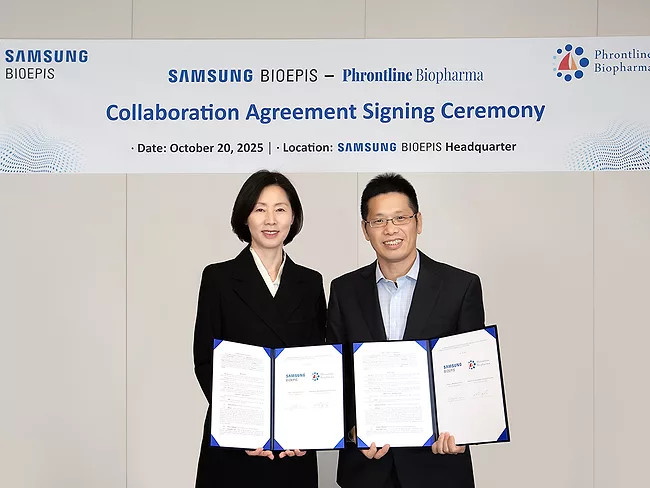
Samsung Bioepis Co. Ltd. announced Oct. 21 the signing of a license deal to codevelop, manufacture and commercialize two of Phrontline Biopharma Suzhou Co. Ltd.’s novel bispecific dual-payload antibody-drug conjugate (ADC) candidates.
Jiangsu Hengrui Pharmaceuticals Co. Ltd. struck another $1 billion-plus deal, this time for a HER2-targeting antibody-drug conjugate (ADC), trastuzumab rezetecan (SHR-A1811), with Glenmark Pharmaceuticals Ltd.’s subsidiary Glenmark Specialty SA.
“New explosions in biotechnology are allowing us to interrogate cancers at a very sophisticated level compared to before,” Dennis Slamon told audience members at the Global Bio Conference in Seoul, South Korea Sept. 3.
Daiichi Sankyo Co. Ltd. and Merck & Co. Inc.’s antibody-drug conjugate (ADC) ifinatamab deruxtecan produced a confirmed 48.2% objective response rate in a phase II study of previously treated patients with extensive-stage small-cell lung cancer.
Detailed data are expected later, but partners Biontech SE and Duality Biologics Co. Ltd. are celebrating a phase III interim analysis readout demonstrating that HER2-targeting antibody-drug conjugate (ADC) trastuzumab pamirtecan hit the primary endpoint of progression-free survival in patients with HER2-positive unresectable or metastatic breast cancer who have previously received trastuzumab and a taxane-based chemotherapy.
Several South Korean biotech and biopharmaceutical companies completed IND submissions or won nods to start clinical trials in either the U.S. or South Korea, including SK Bioscience Co. Ltd., Genosco Inc., Pimedbio Inc., Sillajen Inc. and Ami Pharm Co. Ltd.
About two years since its founding, new company Radiance Biopharma Inc. signed a deal in which it could pay up to $1.165 billion to Novatim Immune Therapeutics Co. Ltd. for global rights outside of certain Asian countries to a bispecific nanobody antibody-drug conjugate that targets c-MET and EGFR to treat solid tumors.
 RSS
RSS