Three months after agreeing to an intellectual property waiver for COVID-19 vaccines, World Trade Organization (WTO) members are discussing expanding it to therapies, diagnostics and devices used in preventing, diagnosing and treating COVID-19 infections.
The 2022 Albert Lasker Basic Medical Research Award has been awarded to Richard Hynes, of the Massachusetts Institute of Technology, Erkki Ruoslahti, of the Sanford Burnham Prebys Medical Discovery Institute, and Timothy Springer, of Harvard Medical School.
The University of Texas MD Anderson Cancer Center and Radiopharm Theranostics Ltd. have launched Radiopharm Ventures LLC, a joint venture (JV) that will develop radiopharmaceutical therapies for cancer. Radiopharm Theranostics owns 51% of shares in the new entity, while MD Anderson owns 49%.
Big pharma is increasingly turning to Taiwan to leverage the power of the country’s data and computing power as precision medicine takes center stage in drug development, speakers said during the recent BIO Asia-Taiwan conference in Taipei.
After political leaders across the globe made patents and other intellectual property safeguards the scapegoat for disparities in access to COVID-19 vaccines, the biopharma industry is sharing its vision for how to deal with the foundational issues of equitable access in pandemics to come – and it has nothing to do with IP waivers like the one World Trade Organization members adopted last month.
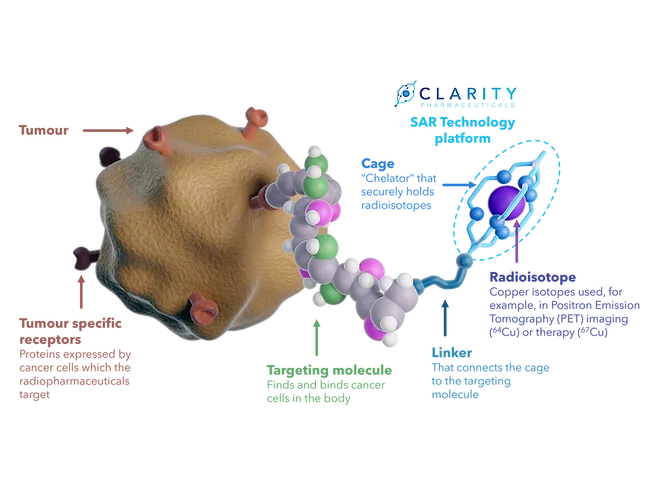
Clarity Pharmaceuticals Ltd. is progressing three of its targeted copper theranostics through the clinic that are based on its sarcophagine technology that securely holds copper isotopes inside a cage-like structure, called a chelator. The SAR technology allows a unique pairing of copper isotopes, copper-64 and copper-67, for both cancer diagnosis and therapy.
A lot of eyes are on the World Trade Organization (WTO) Ministerial Conference taking place in Geneva June 12-15, as member countries try to reach a consensus on a proposal that would allow certain members to waive intellectual property (IP) rights on COVID-19 vaccines for at least three to five years.
A year after the World Health Organization's (WHO) Independent Panel for Pandemic Preparedness and Response called for reforms to make COVID-19 the last pandemic, the panel remains solidly frustrated in its lack of progress. The WHO’s director general, Tedros Adhanom Ghebreyesus, emphatically agreed on May 18, saying he was taken aback by data showing COVID-19 cases rose in four out of the six WHO regions just in the past week.
A proposal hammered out by the EU, India, South Africa and the U.S. to allow IP waivers for COVID-19 vaccines is headed to all members of the World Trade Organization (WTO) for consideration.
 RSS
RSS