Xenter Inc. has officially launched, positioning itself as the first startup device/data/drug med-tech company. The company is developing wireless solutions for interventional cardiology, interventional radiology and neurointerventional radiology.
Xenter Inc. has officially launched, positioning itself as the first startup device/data/drug med-tech company. The company is developing wireless solutions for interventional cardiology, interventional radiology and neurointerventional radiology. The company’s goal is to take the medical devices that have been used most ubiquitously throughout medicine, one by one, and replace them with smart technologies that incorporate such things as software, sensors and signals technologies.
Vysioneer Inc. has won the FDA’s nod for its Vbrain artificial intelligence (AI)-powered tumor autocontouring software. The company said Vbrain is the first AI device to receive FDA clearance for tumor autocontouring in radiation therapy. Vbrain is a neural network-based AI solution, trained from clinical data.
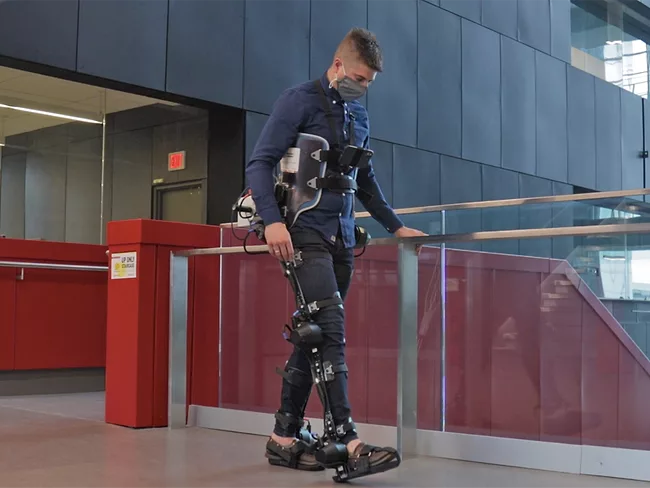
TORONTO – Robotics researchers at Ontario’s University of Waterloo are stealing a page from makers of autonomous or self-driving vehicles, developing wearable, motor-controlled technology to restore physical mobility in people with disabilities without the need to think about or guide the system. The project, called Exonet, is being led by Brokoslaw Laschowski, who contrasts this approach with engineers ramping up the ability of users to control the exoskeleton.
TORONTO – “There’s no magic pill that helps patients with concussion except physical activity,” Ashleigh Kennedy, CEO of Neurovine Inc. told BioWorld. But how does a patient in rehab know when to put on the brakes if they’re working too hard physically or mentally?
Somalogic Inc. has agreed to go public via a merger with blank-check company CM Life Sciences II. Upon closing, CMLS II – a special purpose acquisition company (SPAC) sponsored by affiliates of Casdin Capital LLC and Corvex Management LP – will be renamed Somalogic and its common stock listed on the Nasdaq Global Market under the ticker symbol SLGC.
The rapidly expanding field artificial intelligence (AI)-aided image analysis received a boost with the FDA 510(k) clearance for Optellum Ltd.’s Virtual Nodule Clinic, which helps clinicians evaluate small, potentially malignant lung lesions or nodules. The action makes Optellum’s system the first cleared radiomic application for early lung cancer, an area of active research for the last five years.
The U.S. FDA has granted breakthrough device designation to Tempus Inc. for its ECG Analysis Platform. Developed in collaboration with Geisinger, the artificial intelligence (AI)-powered platform helps clinicians identify patients at increased risk of developing atrial fibrillation (AF) or atrial flutter.
HONG KONG – Israel and U.S.-based Rsip Vision Ltd. unveiled an advanced joint segmentation tool to assist with the planning of revision arthroplasty and other orthopedic procedures for patients with pre-existing metal implants. The detailed, noninvasive artificial intelligence (AI)-based software module enables quick and accurate segmentation of different joints from CT scans of hips, knees, shoulder and spines.
The COVID-19 pandemic has affected wide swaths of the global economy, mostly in a negative manner, but it has spurred some types of innovation at a rate that would be unimaginable in ordinary times. That seems to be the take-away for an emergency use authorization (EUA) granted to Miami-based Tiger Tech Solutions Inc. for its COVID Plus monitor, which uses plethysmography and a machine learning algorithm to provide a screening mechanism at mass gatherings, thus bringing the world one step closer to a state of normalcy.
 RSS
RSS