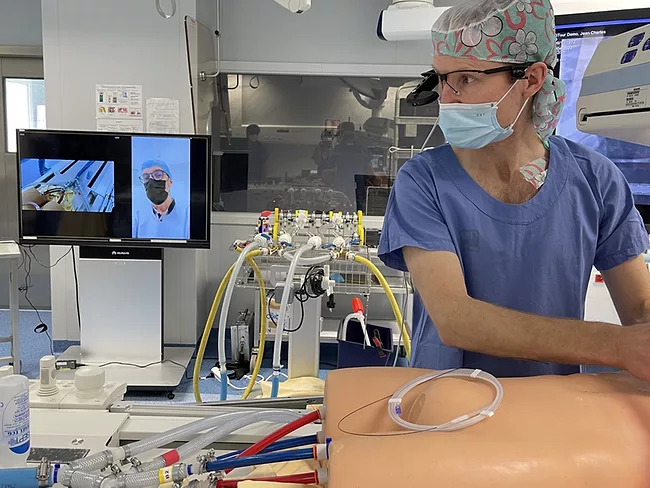
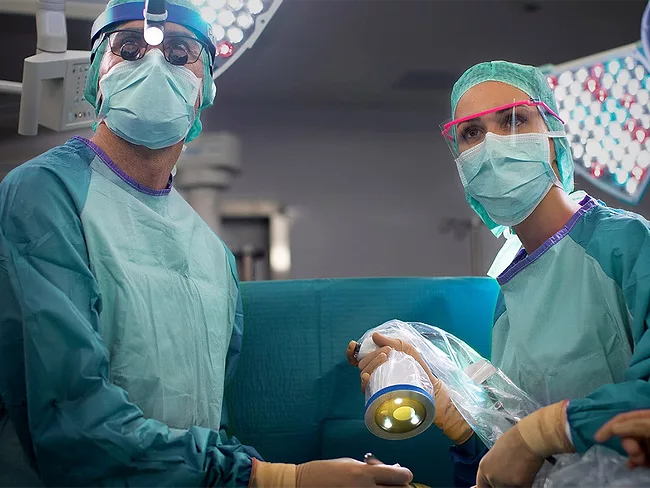
Rennes University Hospital in France has just this April completed a surgical procedure in the operating room wirelessly, thanks to the 5G network. Cardiologist Erwan Donal performed a heart operation there on a simulation manikin, monitored remotely from Athens, Greece, by heart surgeon Alexandros Stefanidis, from the department of cardiology at the General Hospital of Nikea.
Apollo Global Management Inc. is taking a minority equity interest in European venture capital firm Sofinnova Partners, pledging to commit of up to €1 billion (US$1.04 billion) in managed capital to the latter’s investment coffers.
Valneva SE’s share price plummeted May 16 after the European Commission decided to terminate an advance purchase agreement for millions of doses of its COVID-19 vaccine candidate VLA-2001 because of delays in development. The company’s shares (Paris:VLA) fell more 19% to €9.65 (US$10.07) after it said it would reconsider its financial guidance for 2022.
Getinge AB is acquiring 100% of the equity in fluorescence imaging company Fluoptics SAS, a company using the technology as an aid to surgery. Getinge will, through its subsidiary Getinge Infection Control SAS, acquire all outstanding shares in Fluoptics and will pay around $27 million in cash on closing the deal.
Germitec SA has raised €11 million (US$11.6 million) to finance commercial scale-up, as it prepares to submit for FDA 510k approval of its ultrasound probe disinfection system.
The music still goes on for biotech investment – it’s just not as loud and vibrant as it was during the heady days of 2020 and 2021, according to experts at this year’s LSX World Congress in London. After the rush to invest in biotech during the last two years, it has become an uphill battle to raise money – but the message from several panel experts at the event is that there is still hope.
First results from the U.K. Cov-Boost trial, looking at responses to a fourth dose of an mRNA COVID-19 vaccine, show that antibody levels increase more than after the third dose, confirming the precautionary move to give the most vulnerable a second COVID-19 booster in advance of immune response data being available.
In response to the COVID-19 pandemic, health systems around the world are looking to digital technologies to support health delivery but where exactly can these technologies have the most impact? At the Medtech Forum in Barcelona, European leaders gathered to discuss practical examples of how digital tools can help make health systems more efficient.
When it comes to innovation, Europe has a thing or two it can learn from the U.S. according to European leaders. Speaking at the Medtech Forum meeting in Barcelona, Medtech Europe CEO Serge Bernasconi said Europe’s focus on safety issues is stifling innovation across the continent.
A lack of funding for combination therapies in the U.K. could hold back investment in the country’s biopharma sector – but there are moves afoot to find ways around the issue, pinned by industry on the way the National Institute for Health and Care Excellence (NICE) assesses the value of drugs.
 RSS
RSS