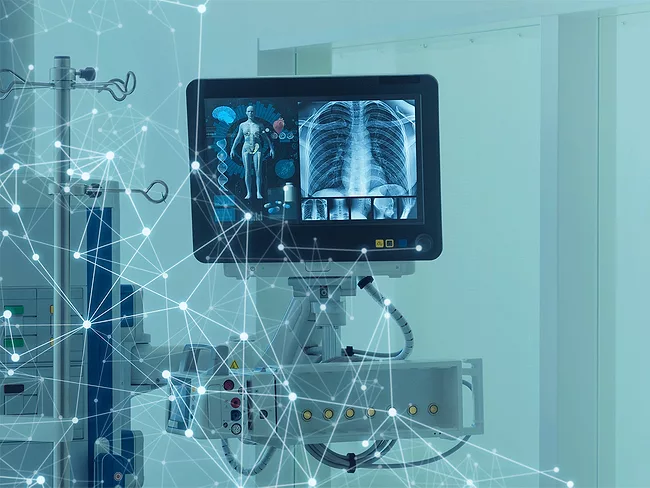
BERLIN – The German government has just made $3.6 billion available to the Future of Hospitals Act (Krankenhauszukunftsgesetz, KHZG), through the liquidity reserve of the health fund in order to support public hospitals with digital transformation. Besides this government cash injection, an additional $1.6 billion will be made available through co-funding by the German federal states, the 16 Länder. In total, German hospitals will get a $5.2 billion funding to boost digitization.
LONDON – The U.K. National Institute for Health and Care Excellence (NICE) has published new advice on how and when artificial intelligence (AI) could be applied to the interpretation of mammograms and chest computer tomography images, in a move that is intended to set the ground rules for the uptake of these technologies. In population breast screening, NICE looked at how five AI systems could be used to pick out mammography images that need further assessment, supporting qualified radiologists in their interpretation.
DUBLIN – Amid a bitter dispute between the European Commission (EC) and Astrazeneca plc over supplies of the latter’s SARS-CoV-2 vaccine, the EC’s drug regulator, the EMA, recommended approval of the product in question, COVID-19 Vaccine Astrazeneca (formerly AZD-1222).
LONDON – A fourth COVID-19 vaccine is on the road to approval in Europe, with Novavax Inc. announcing positive interim data from the phase III U.K. trial of NVX-CoV2373. The vaccine was 89.3% effective at a time when there was a high rate of infection in the country, and in the face of the newly identified variant, B 1.1.7, which is more transmissible. There also was positive data, though slightly less sparkly, from a phase IIb study in South Africa, where NVX-CoV2373 showed 60% efficacy in preventing mild, moderate and severe COVID-19 disease.
PARIS – Neos Surgery SL has been awarded funding under the leading European program for innovative SMEs, the EIC accelerator. (previously known as SME Instrument). This Spanish med-tech company was one of just 38 projects selected from among 4,200 applicants from 18 countries across Europe. Neos has been awarded a non-repayable grant of $2.3 million towards developing its groundbreaking Disc Care device, used in the treatment of herniated disc.
LONDON – There is “a realistic possibility” that infection with the B 1.1.7 variant of SARS-CoV-2 is associated with a 30% to 40% increased risk of death compared to earlier variants of the virus, according to scientists on the U.K. government’s New and Emerging Respiratory Virus Threats Advisory Group. That conclusion is based on studies by three university groups, linking community PCR testing to mortality.
The implementation date for the European Union’s In Vitro Diagnostic Regulation (IVDR) is a mere 16 months away, although there is widespread interest in a delayed implementation date. Nonetheless, Warren Jameson, principal regulatory consultant for North American Science Associates (NAMSA) of Toledo, Ohio, urged test makers to conduct a gap analysis of the conformity of their currently marketed tests to the new regulations because a large percentage of the underlying dossiers would not pass muster under the terms of the new regulatory regime.
PARIS – France’s Comité Economique des Produits de Santé (CEPS), which reports to the Ministry of Health, has released its latest financial figures for medical device reimbursement. Health insurance expenditures amounted to $11.6 billion during the last full financial year reported by CEPS, representing annual growth of 4.66%. Over the last two years, more than half of expenditures have focused on four therapy areas: orthopedics, pulmonology/ENT, cardiac and vascular systems, and diabetes.
LONDON – A new national consortium of virologists has been set up to systematically assess how mutations in SARS-CoV-2 affect key outcomes such as effectiveness of vaccines and therapies, transmissibility of the virus and the severity of COVID-19 infections.
LONDON – A new national consortium of virologists has been set up to systematically assess how mutations in SARS-CoV-2 affect key outcomes such as effectiveness of vaccines and therapies, transmissibility of the virus and the severity of COVID-19 infections. Now is the critical time to do this, as the level of both natural and vaccine-conferred immunity that might drive natural selection is increasing, said Wendy Barclay, head of the department of infectious disease at Imperial College London, who is leading the G2P-UK (Genotype to Phenotype-UK) project.
 RSS
RSS