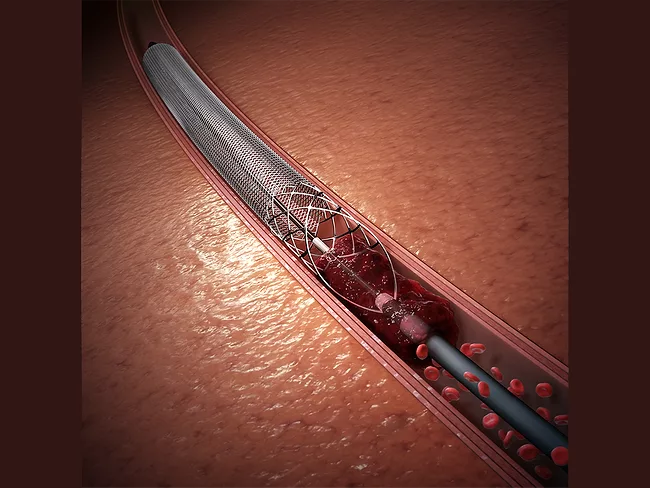
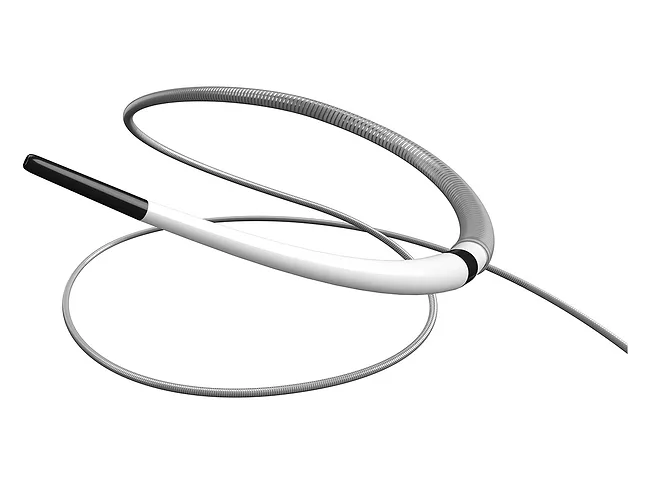
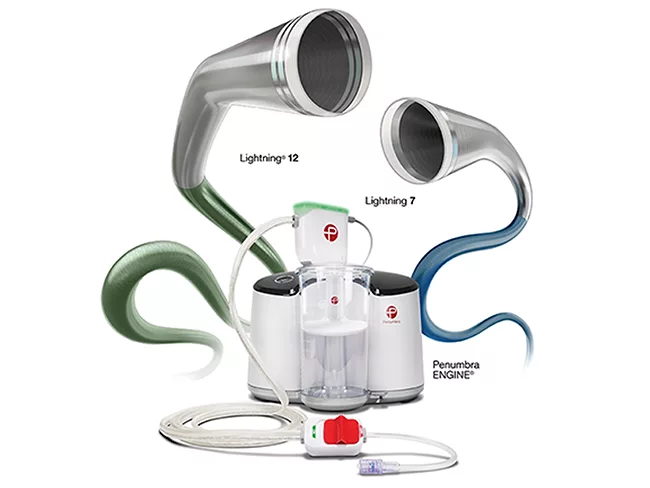
Boston Scientific Corp.’s intent to acquire Penumbra Inc. for $14.5 billion will not only allow it to expand its minimal invasive care portfolio in areas such as embolization and peripheral vascular disease, but to also reenter the neurovascular space, Kathleen Van Vlierberghe, vice president of Peripheral Interventions EMEA, told BioWorld.
Boston Scientific Corp. looked ready to keep steamrolling down the acquisition path, carrying the momentum from last year, with the news that it is acquiring Penumbra Inc., a company that makes devices for interventional therapies to treat vascular conditions such as stroke and aneurysm, for a whopping $14.5 billion.
Penumbra Inc.’s 'resoundingly positive' results from its STORM-PE trial could see current guidelines for anticoagulant use in pulmonary embolism swept away in favor of mechanical thrombectomy. A deluge of favorable comments by experts and analysts followed the presentation during a late-breaking session at Transcatheter Cardiovascular Therapeutics, the annual scientific symposium of the Cardiovascular Research Foundation, which showed more than 50% improvement in treatment effect from Penumbra’s computer-assisted vacuum thrombectomy system plus anticoagulation compared to anticoagulation alone within two days with no increase in major adverse events.
A late-breaking study presented at the PERT Consortium 2025 Pulmonary Embolism Scientific Symposium in San Diego showed marked clot-burden reduction with no device-related serious adverse events for Imperative Care Inc.’s Symphony thrombectomy system, though other companies have a head start. Circulation: Cardiovascular Interventions simultaneously published the study in an article titled “A Prospective Multicenter IDE Study of the Next-Generation Precision Aspiration Thrombectomy System for Intermediate-Risk Pulmonary Embolism: The SYMPHONY-PE Trial.”
Two med-tech companies focused on pulmonary embolism overcame their own blockages to commercialization this week. Inquis Medical Inc.’s Aventus thrombectomy system received U.S. FDA clearance for use in pulmonary embolism, an expanded indication, while Penumbra Inc. completed enrollment in the STORM-PE clinical trial of its Lightning Flash device.
With more than 60 acquisitions completed in the last decade, Stryker Corp. shows little fear in committing to offers that allow it to obtain the companies and technologies that have driven its impressive growth in stock price – up from $92 in Jan. 2015 to $356.70 in Jan. 2025. Still, the definitive agreement to buy Inari Medical Inc. for $4.9 billion comes in at the upper range, along with the $4 billion acquisition of Wright Medical Group NV in 2020 ($5.4 billion with debt included), $3 billion for Vocera Communications in 2022, and $2.8 billion for Sage Products in 2016.
The FDA gave the greenlight to Route 92 Medical Inc. for its Freeclimb 70 reperfusion system in the treatment of ischemic stroke. The 510(k) clearance includes a Freeclimb 70 aspiration catheter, as well as a Tenzing 7 delivery catheter.
Cardiovascular Systems Inc. (CSI) reported the submission by its partner Innova Vascular Inc. of U.S. FDA premarket notification for thrombectomy devices to treat peripheral vascular disease. Already an acknowledge leader in atherectomy technologies, St. Paul, Minn.-based CSI intends to acquire and commercialize each device to expand its technology portfolio to include treatment of deep vein thrombosis (DVT) and pulmonary embolism (PE).
Penumbra Inc. presented new data at the LINC Symposium in Leipzig, Germany, evaluating its Indigo aspiration system for submassive pulmonary embolism (PE). The subgroup analysis evaluated performance outcomes of patients with main pulmonary artery (PA) emboli vs. discrete unilateral or bilateral PA emboli without main PA involvement. Data from the study suggests the system can be used effectively for both proximal and distal aspiration thrombectomy in the pulmonary arteries.
The U.S. Centers for Medicare & Medicaid Services (CMS) has proposed to drop its national non-coverage policy for pulmonary embolectomy, a procedure for which multiple devices have been cleared or approved by the FDA. Several stakeholders, including more than one med-tech trade association, had requested such a change, and CMS indicated that much more evidence will be needed before it can forge a national coverage policy that would eliminate the impending geographically differentiated patient access.