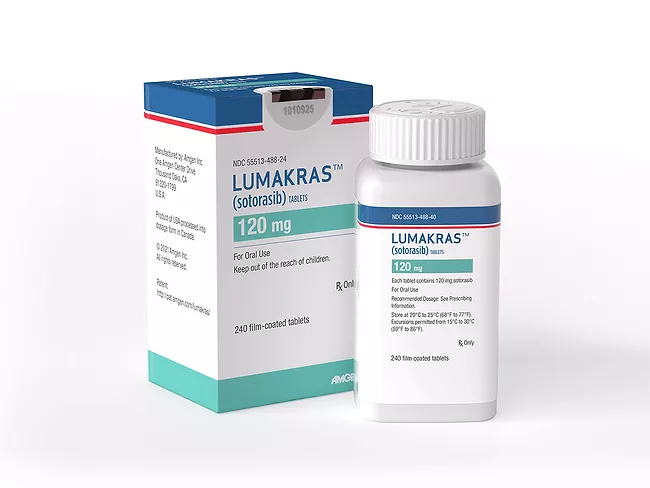
The dark cloud of what the U.S. FDA called potential “systemic bias” rained on Amgen Inc.’s bid for full approval of Lumakras (sotorasib), a KRAS-G12C inhibitor that was granted accelerated approval in May 2021 for locally advanced or metastatic non-small-cell lung cancer after at least one systemic therapy.
Bad news for Amgen Inc. could mean upside for Mirati Therapeutics Inc., though the meeting of the U.S. FDA’s Oncologic Drugs Advisory Committee (ODAC) has yet to tell the tale regarding Lumakras (sotorasib), the former’s KRAS-G12C inhibitor.
Aethon Therapeutics Inc. closed a $30 million series A round to develop a novel antibody-based therapeutic strategy for cancer, which relies on the concomitant use of small-molecule covalent inhibitors that form peptide-drug conjugates or beacons.
As largely expected, Mirati Therapeutics Inc.’s adagrasib gained U.S. FDA accelerated approval ahead of its Dec. 14 PDUFA date, cleared for second-line use in patients with non-small-cell lung cancer (NSCLC) harboring the KRAS G12C mutation, in which it will go up ahead Amgen Inc.’s Lumakras (sotorasib), which has the advantage of a year and a half head start.
Data presented Sept. 9 at the European Society of Medical Oncology 2022 Congress showed impressive effects for KRAS inhibitors. But they also illustrated their limitations. Earlier-stage trials and researcher presentations, meanwhile, suggested ways those limitations might be addressed. Results from the Codebreak 200 study, presented in the day’s Presidential Symposium, were typical of the best that targeted therapies have to offer: large effects for brief time periods.
There was no slowing of biopharma innovation in 2021, even as industry directed significant resources to, while feeling the impact of, the ongoing COVID-19 pandemic. The year saw big wins for developers of DNA vaccines and biosimilars, while CAR T expanded its reach and a drug target once considered undruggable was finally conquered. And as 2021 gives way to 2022, other potentially game-changing technologies and therapeutics are waiting in the wings.
Though Revolution Medicines Inc.’s SHP2 inhibitor, RMC-4630, fell short of internally set benchmarks in a pair of phase I combo trials, the prospect remains alive, as the company has been “very publicly moving towards combining the companion inhibitors that we have, which include RMC-4630 with RAS inhibitor therapies that we and others make,” said Steve Kelsey, president of R&D.
The FDA has given a green light to Foundation Medicine Inc.’s Foundationone CDx as a companion diagnostic for Takeda Pharmaceutical Co. Ltd.’s Alunbrig to identify patients with anaplastic lymphoma kinase (ALK)-positive metastatic non-small-cell lung cancer (NSCLC). The approval comes as Laboratory Corp. of America Holdings (Labcorp) is launching a companion diagnostic to identify NSCLC patients with the KRAS mutation. NSCLC accounts for about 85% of all lung cancers, with an estimated 1.8 million new cases diagnosed each year worldwide. Of those, 3% to 5% carry the ALK gene mutation, which is often missed with standard testing methods.
Amgen Inc.’s Merdo Gordon, head of commercial global operations, said just-approved Lumakras (sotorasib) is “priced very well compared to other targeted medicines available in the market” for cancers driven by specific mutations. “Just characterizing the launch broadly, look, it’s really hard to tell because of the variability of our reach to customers right now” – a result of the COVID-19 pandemic.
Well ahead of the assigned Aug. 16 PDUFA date, Amgen Inc. bagged accelerated clearance from the FDA for Lumakras (sotorasib), the first targeted therapy for adults with KRAS G12C-mutated locally advanced or metastatic non-small-cell lung cancer (NSCLC), as determined by an FDA-approved test.