
Linkgevity targets aging as it joins startup accelerator KQ Labs
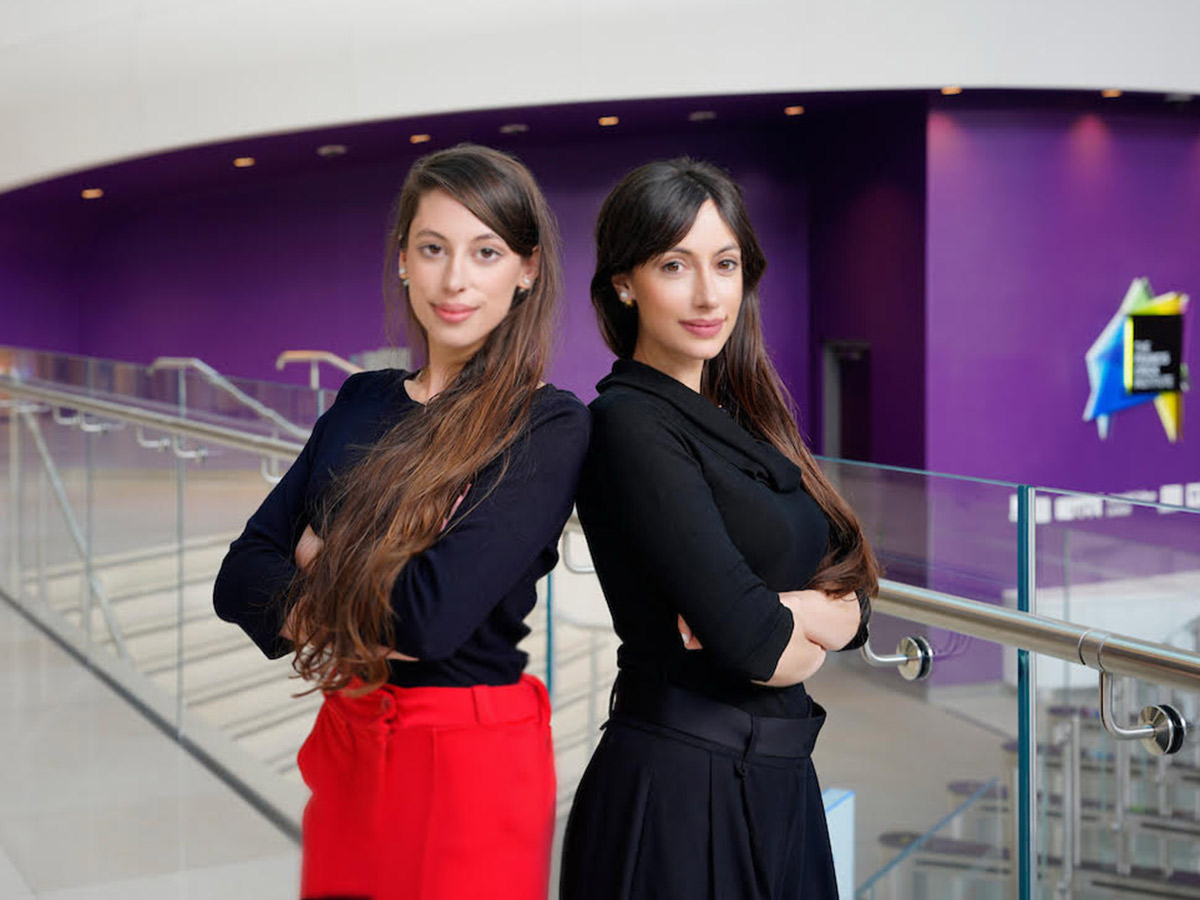
Linkgevity founders Carina Kern, CEO, (left) and Serena Kern-Libera, chief operating officer, at the Francis Crick Institute in London.
By: Nuala Moran, staff writer
Originally published Jan. 24, 2025, in BioWorld
Linkgevity Ltd. has won backing from the KQ Labs accelerator program at the Francis Crick Institute in London, enabling it to take forward the lead program, an anti-necrotic drug for treating acute kidney injury, and to further develop its AI-driven system for identifying aging-related therapeutic targets.
Alongside access to the Crick’s expertise in translational research and in shaping academic science to make it investible, companies joining KQ Labs receive an equity investment.
“This program will be pivotal to our plans, which include initiating a clinical trial for kidney disease,” said Carina Kern, CEO and co-founder of Linkgevity. “What is additionally exciting is that the kidney provides an accelerated aging model to validate this drug as a candidate to treat aging more broadly.”
Kern is the author of the “Blueprint theory of aging,” a framework for interrogating the medical literature to uncover linked molecular pathways that underlie aging and age-related diseases.
Initial analyses led on to the drawing of Blueprint maps that catalogue triggers of aging at every level of biology, from cellular dynamics to whole organ function, providing the inputs for AI-driven drug discovery. In addition to identifying novel targets, the technology also could be used for risk factor analysis and disease prediction.
“The Blueprint focuses on taking a systems biology approach, whereby it puts into context all of the different changes that take place with age. It takes into account the fact that you know these different changes and diseases are interlinked,” Kern told BioWorld.
“A key feature is to connect different disciplines: You can go from genetic and molecular level changes, to understanding cell-level changes and the tissue- and physiology-level changes that underlie tangible age-related diseases,” Kern said.
Uncovering the molecular roots of aging opens the way to developing drugs that are effective against multiple age-related diseases.
“As an analogy, think of antibiotics. … They revolutionized not just one infectious disease, but a whole host of infectious diseases. So, the question is, can you identify the antibiotic equivalent for aging?” said Kern.
Interestingly, the Blueprint theory, first published as a preprint in October 2023, provides another analogy, in that it foresaw GLP-1 receptor agonists would have utility beyond diabetes and obesity. That is now proving to be the case, with the most recent report showing diabetic patients prescribed these drugs had a reduced risk of 42 diseases, and an increased risk of 19.
Ubiquitous and profound
Linkgevity has chosen necrosis as the exemplar to demonstrate its platform can identify targets of relevance to multiple diseases. Necrosis is a ubiquitous and profound molecular pathway, and proof of concept in acute kidney injury would lead on to a range of other indications.
Inhibiting necrosis also would be of value in preserving organ transplants and in tissue engineering.
Applying the Blueprint map to drug discovery involves homing in on the best point to intervene. “Multiple different changes or stressors all culminate on the same endpoint of necrosis, and once you get necrosis, that gives you both your direct tissue damage and it also results in other cascades,” said Kern. “We’ve identified this node, where the different stressors culminate and problems flow out from.”
The lead compound is a novel combination of two FDA approved drugs, but which, Kern said, “were never envisaged” for treating acute kidney injury or age-related conditions.
Linkgevity co-founder and chief operating officer, Serena Kern-Libera, who is the sister of Carina Kern, said the program will move into clinical development this year. “Because we’re repurposing drugs, …. we’re hoping to be able to move straight to phase II,” she said.
As part of the trial, Cambridge, U.K.-based Linkgevity aims to include biomarkers of aging as an endpoint. “No drug so far has been approved to treat aging, and one of the reasons is that in most cases the mechanisms through which you see aging-related decline are unknown,” Kern-Libera said.
However, one of Linkgevity’s academic collaborators has established there is mechanistic link between necrosis and aging in the kidney, and which also is relevant to aging elsewhere in the body.
“You get the same mechanism across all of biology,” said Kern-Libera. Measuring aging biomarkers as a clinical endpoint would show if the lead compound modulates this molecular root of multiple age-related changes.
Linkgevity’s approach has convinced the U.S. space agency NASA, which selected the company for its NASA/Microsoft Space H program, based on the potential of the lead compound to prevent accelerated aging, and, in particular, kidney deterioration in astronauts.
“Necrosis is an even bigger problem than on Earth, because you have all these additional stressors in space,” Kern said.
For sales inquiries, visit clarivate.com/cortellis/solutions/bioworld or call U.S.: +1 215-386-0100; Europe: +44 207-433-4000; China: +86 105-760-1200. For customer service inquiries: clarivate.com/cortellis/contact-us